



3D visualization for real estate developers helps sell off-plan units faster because it gives buyers something clearer to trust before the built product exists. For developers, that means 3D is no longer only a design presentation asset. It is part of the commercial system that supports launch confidence, buyer engagement, and stronger sales conversations.
That matters because modern buyers increasingly expect digital clarity before they commit. Matterport reports that listings with 3D tours sold up to 31% faster and for up to 9% higher prices, while Zillow says listings with 3D Home tours receive 43% more views, are saved 55% more often, and tend to sell faster than comparable listings without them. These numbers come from the resale market, but the underlying buyer psychology applies directly to off-plan sales as well. Sources: Matterport 3D tour research, Zillow 3D Home performance data.
For developers in the UAE, USA, and Canada, the implication is simple. The more clearly a buyer can understand the product digitally, the easier it becomes to shorten hesitation.
What 3D visualization actually means for developers
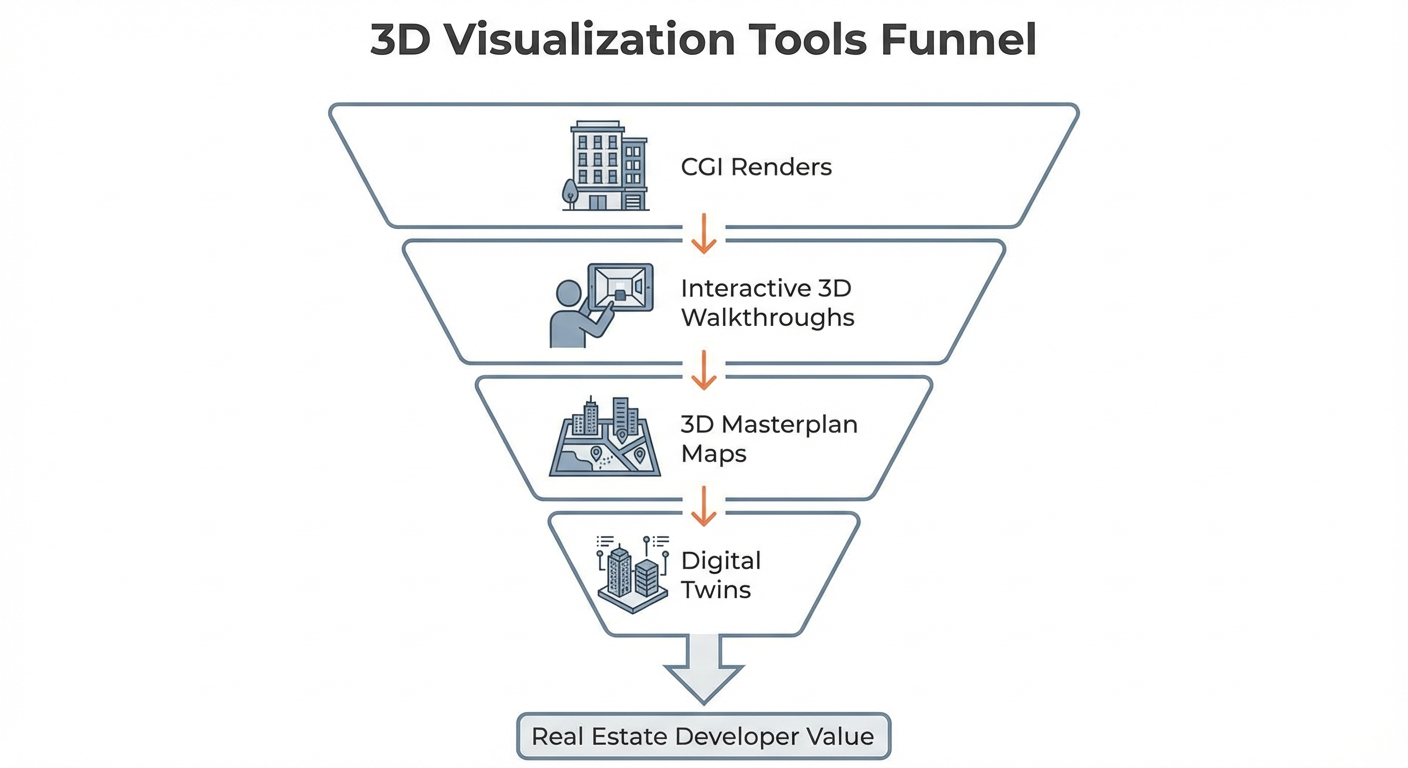
For developers, 3D visualization usually includes four practical layers:
- CGI stills and hero renders for websites, campaigns, portals, and brochures.
- Interactive walkthroughs and virtual tours for remote exploration.
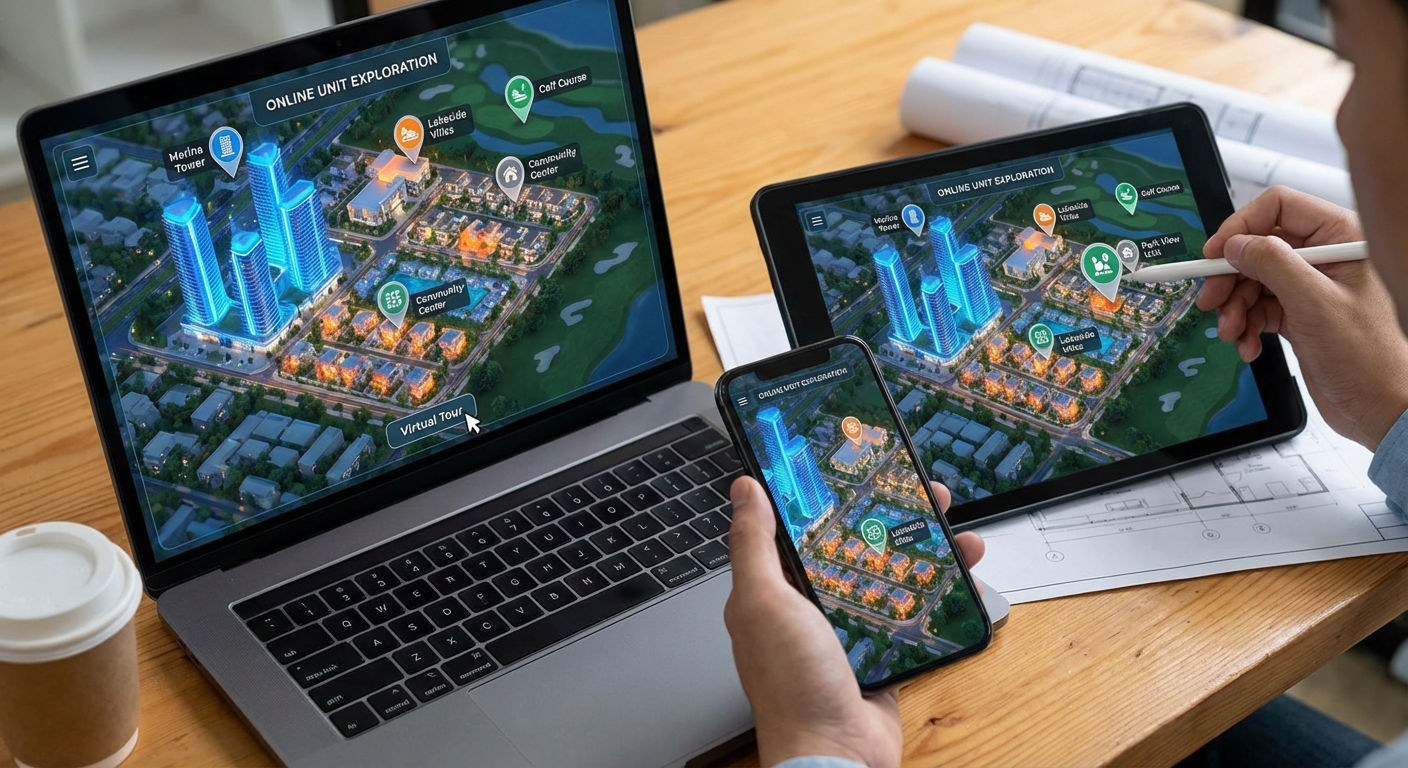
- Masterplan explorers and unit selectors for comparing specific options.
- Data-connected tools that can later integrate with availability, pricing, and sales workflows.
This is why 3D should not be treated as a single deliverable. A stronger developer strategy uses different 3D assets for different stages of the buyer journey.
Why 3D helps off-plan units sell faster
It reduces abstractness
Off-plan buyers are being asked to commit before construction is complete. 3D visuals make the offer easier to imagine and easier to evaluate.
It improves remote decision-making
International investors, out-of-market buyers, and time-poor prospects can engage with the project without needing a physical site visit first.
It strengthens sales conversations
Sales teams can explain layouts, views, amenities, and unit differences more effectively when they have interactive tools instead of static PDFs alone.
It makes premium positioning more believable
A strong 3D experience helps the project feel more real, more intentional, and more commercially serious.
The 3D tools stack developers should think about
A practical 3D stack usually includes a mix of formats rather than one universal solution.
CGI renders
These are still the visual foundation for launch campaigns. They help create first impression, shape aspiration, and support media assets across multiple channels.
Virtual tours
These are useful when the developer needs stronger immersion, especially for overseas buyers or higher-consideration unit types.
3D unit selectors and masterplan explorers
These tools help buyers compare specific options. They are especially useful for larger communities, towers with many layouts, or projects where view and orientation matter commercially.
Sales-gallery and presentation tools
In many off-plan environments, 3D also supports in-person selling by giving the team a more polished and persuasive way to present the project.
Where 3D fits in the developer sales funnel
3D is most effective when it is mapped across the full funnel.
Awareness
Use hero CGI, teaser animations, and high-impact visuals to make the project legible in ads, portals, and public launch assets.
Consideration
Embed renders, walkthroughs, and selected 3D experiences into the project website or microsite so buyers can move from curiosity to understanding.
Conversion
Support specific unit selection, comparison, and enquiry with interactive tools that help buyers narrow down options more confidently.
Post-enquiry support
Sales teams can continue using the same assets in follow-up, remote presentations, and broker conversations so the narrative stays consistent.
This is one reason MARKETIKA’s real estate project portfolio and broader expertise across websites, visuals, and sales tools are useful references. Stronger results usually come from connected digital systems, not isolated renders.
Regional rollout logic: UAE, USA, and Canada
UAE
In the UAE, especially Dubai and Abu Dhabi, buyers already expect polished visual presentation. For many launches, 3D is part of the basic competitive requirement, not a luxury add-on.
USA
In the USA, 3D can help developers stand out within more template-driven discovery environments and support better explanation of future phases, amenities, and unit options.
Canada
In Canada, 3D can reduce uncertainty in pre-construction sales by helping buyers understand layouts, storage, parking, amenity access, and the broader project context more clearly.
A rollout checklist for developers
A useful sequence often looks like this:
- define the core project story first
- decide which visuals belong to awareness versus consideration
- scope the must-have unit types and amenities for 3D coverage
- connect the assets to the website and sales workflow
- track how 3D engagement relates to lead quality and sales progression
The point is not to commission every possible asset. It is to make sure each asset has a commercial role.
What success should look like
When 3D is used well, developers usually gain:
- faster buyer understanding
- stronger remote engagement
- better broker and sales-team confidence
- more useful conversations around specific units
- a more premium and credible digital presentation overall
These benefits matter because they compound. Better clarity at the start of the funnel often improves performance in the middle and end of the funnel too.
Common mistakes developers should avoid
Treating 3D like an isolated creative package
3D performs best when it is connected to the website, the media plan, and the sales workflow.
Overproducing without strategic focus
A smaller set of strong, well-placed assets is usually better than a large unstructured asset library.
Ignoring mobile and web performance
Immersive content should still be easy to access and understand across real buyer devices.
Forgetting the conversion path
Even beautiful 3D content should guide buyers toward a clear next step.
FAQ
Do 3D tools really help sell off-plan units?
Yes. They help buyers understand, compare, and trust the project earlier, which can support stronger engagement and faster progression.
What is the difference between renders and virtual tours?
Renders create curated still visuals, while virtual tours give the buyer a more immersive sense of space and movement.
When do developers need a fuller 3D stack?
Usually when the project is more premium, more complex, or more dependent on remote buyer confidence.
How can MARKETIKA help?
MARKETIKA can connect 3D visualization thinking, developer project examples, and broader digital expertise into a more conversion-aware 3D rollout.
Final takeaway
3D visualization for real estate developers works best when it helps the buyer trust what they cannot yet walk through physically. Developers that treat 3D as part of a connected sales and marketing system create better conditions for faster decisions, stronger confidence, and more effective off-plan selling.
That is what turns 3D from presentation into commercial leverage.