



Brokers can expand the reach of a launch quickly.
They can also fragment it just as quickly when every partner presents the project differently.
That is not usually a broker problem alone. It is often a systems problem. If the developer has not clearly defined the project story, organized current materials, and made updates easy to access, the market ends up with multiple versions of the same launch.
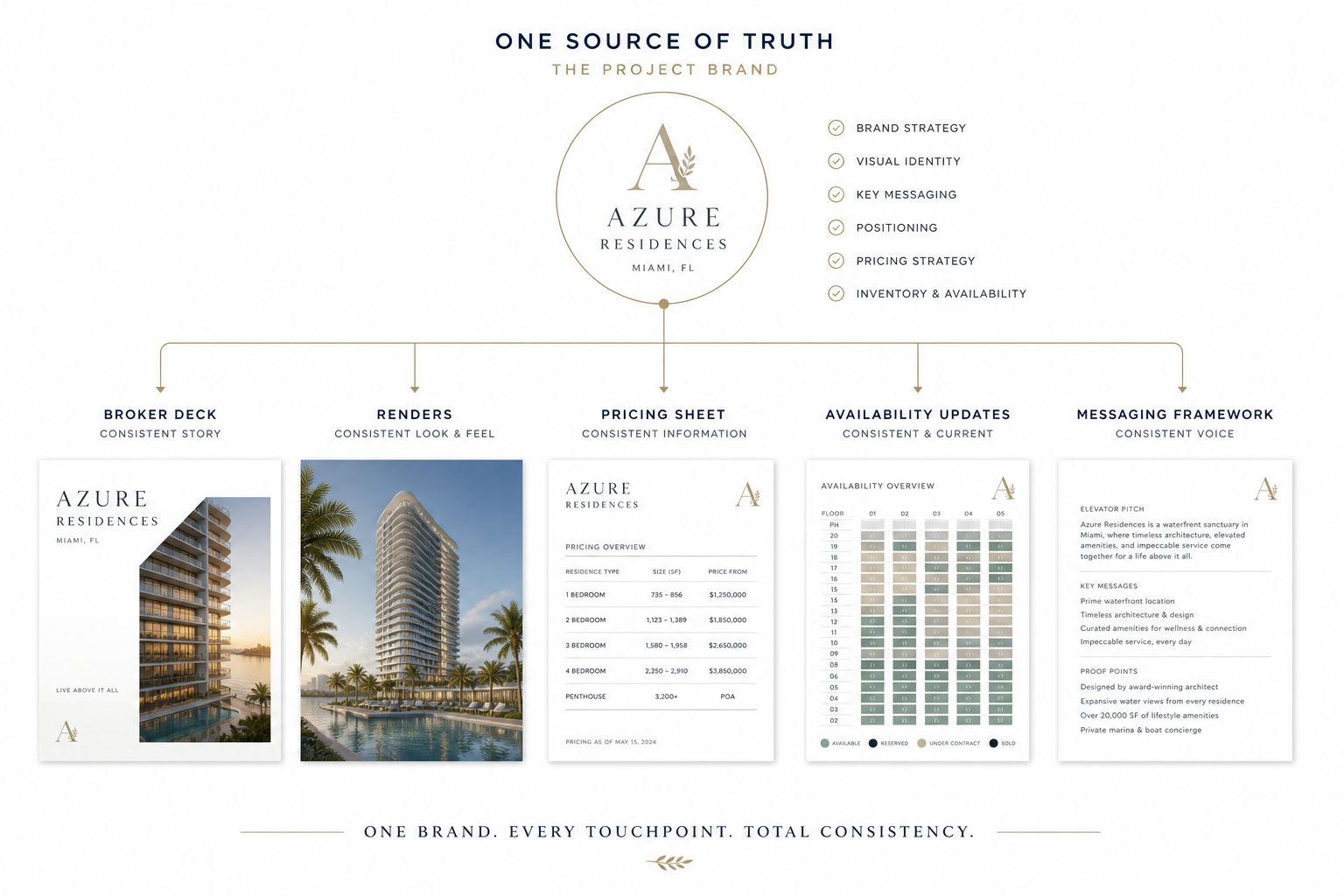
Developers can keep broker marketing consistent by giving partners a clear positioning framework, approved assets, current sales information, messaging guidance, and one reliable source of truth for updates. The goal is not to control every sentence. It is to protect the accuracy and strategic clarity of the project in distribution.
Brokers need more than a folder of files
Many teams assume that sending a pack of renders, logos, and brochures is enough.
It is not.
Brokers also need to understand:
- what the project stands for
- who the priority buyer is
- which proof points matter most
- how the developer wants the opportunity framed
- what information changes frequently
- where to verify the latest version
Without that context, partners improvise. Sometimes they do it well. Often they do it inconsistently.
Why consistency matters more than teams expect
A buyer may encounter the same project through:
- an official website
- one or more brokers
- portal listings
- WhatsApp forwards
- PDF decks
- social media snippets
If the pricing logic, language, visuals, or project story shifts noticeably between those touchpoints, confidence weakens.
This matters especially in pre-construction and off-plan sales, where the audience is already relying on trust signals to evaluate an unfinished product. Inconsistency does not feel like a small admin issue. It feels like uncertainty.
A useful broker toolkit should include
A practical broker-support system often contains:
- a short positioning summary
- approved project description copy
- key proof points and differentiators
- current renders, floorplans, and visual assets
- clear rules around what may change frequently
- source-of-truth availability and pricing references
- contact and escalation logic
- a simple explanation of buyer priorities and sales process
The aim is to make accurate communication easier than inaccurate communication.
One source of truth is essential
The biggest operational issue is usually version control.
Availability changes. Incentives change. Timelines change. Sometimes even the story sharpens during launch.
If brokers rely on old PDFs or disconnected folders, misinformation starts spreading quickly. That creates avoidable friction for both buyers and the internal sales team.
A stronger operating model gives all partners one reliable place to check:
- current visuals
- latest descriptions
- approved project facts
- availability process
- changes in incentives or sales instructions
This is also why brand consistency across touchpoints is not just a design issue. It is a distribution issue.
Consistency should still leave room for broker style
Developers do not need to make every broker sound identical.
That is neither realistic nor always desirable.
The objective is not uniformity in tone. It is consistency in core truth.
That means partners can still communicate in ways that fit their audience, as long as they are working from the same strategic foundation:
- same positioning logic
- same proof points
- same current information
- same product understanding
- same next-step process
This balance protects the brand while still respecting channel differences.
The best broker systems reduce internal cleanup too
When the toolkit is strong, internal teams spend less time:
- correcting old materials
- explaining basic project positioning repeatedly
- clarifying inaccurate claims
- resolving buyer confusion caused by mismatched information
In other words, consistency improves efficiency as well as brand coherence.
Final takeaway
Broker reach is valuable.
The stronger the distribution network becomes, the more important it is to protect one clear and accurate project story.
Developers who provide partners with real strategic support, not just a folder of assets, create a more consistent market experience and a more trustworthy path from first exposure to serious buyer conversation.


