



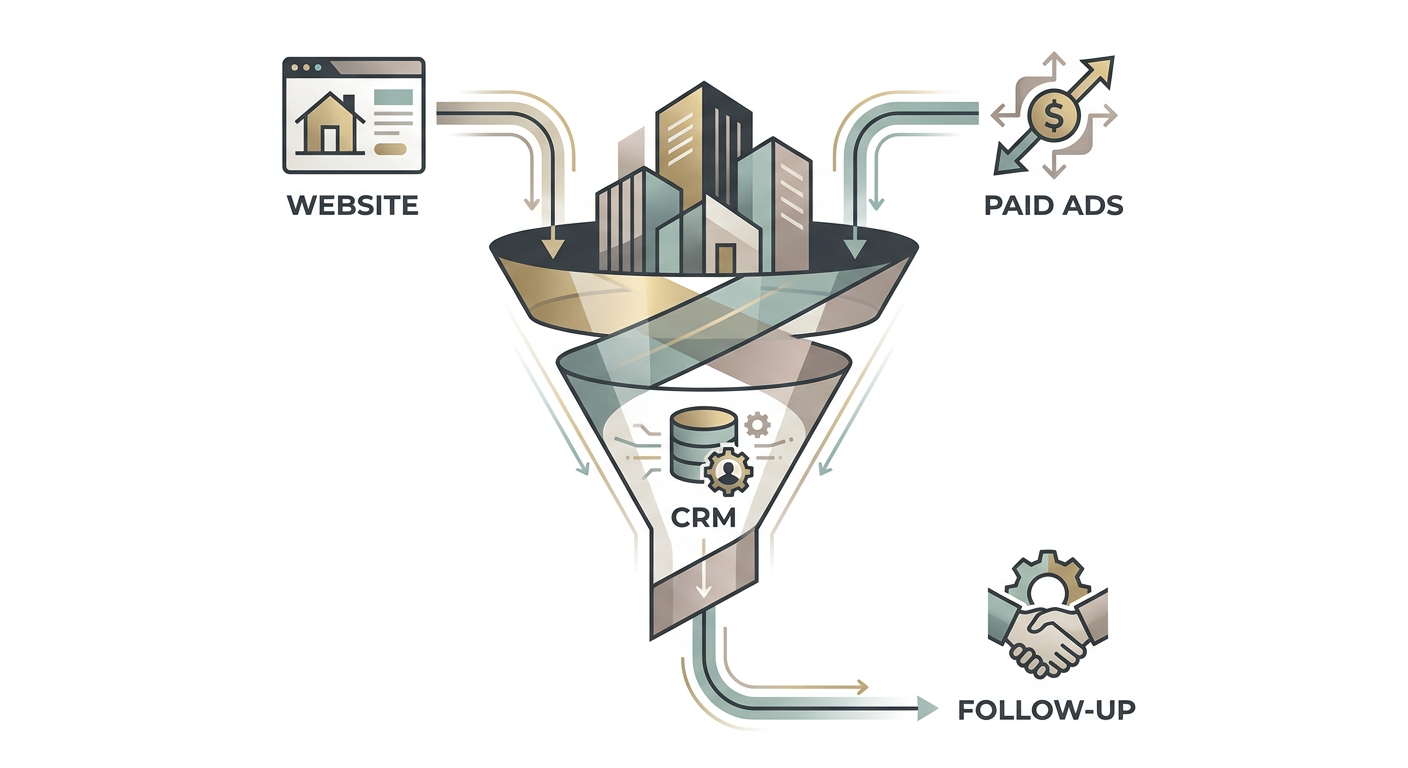
Lead generation for real estate developers works best when websites, campaigns, CRM routing, and follow-up behave like one connected system. When those parts are disconnected, traffic may still arrive, but trust breaks, response slows, and lead quality usually drops before sales ever has a chance to convert interest into meetings.
That matters because buyer discovery is already digital. According to the National Association of REALTORS, 43% of buyers began their home search by looking online for properties for sale, and 2025 buyer findings also show that 52% found the home they purchased through the internet. Adobe reports that 78% of consumers expect consistent experiences across channels, while only 45% feel brands actually deliver them. Salesforce adds another useful lens: disconnected tools and administrative bottlenecks continue to weaken sales performance, especially when teams are expected to move faster with the same or fewer resources. Sources: NAR 2025 home search behavior, 2025 buyer findings summary, Adobe AI and Digital Trends in Customer Engagement, Salesforce State of Sales 2026.
For developers, the implication is clear. Lead generation is not just about buying ads or publishing a project page. It is about designing a system that moves the right audience from awareness to enquiry, then from enquiry to qualified conversation.
What lead generation for developers actually means
Lead generation in real estate development is not simply the act of collecting form fills. It is the process of creating qualified demand for a project, filtering that demand through the right digital experience, and routing it into a sales workflow that can respond well.
That distinction matters because many teams mistake volume for quality. A large number of leads can still produce weak commercial outcomes if:
- the audience targeting is broad or poorly defined
- the website does not explain the project clearly enough
- trust signals are weak
- forms collect interest without enough context
- the CRM and follow-up system fail to separate serious prospects from light curiosity
For developers, good lead generation should answer four questions:
- Are we attracting the right people?
- Does the digital experience help them understand the project quickly?
- Are we capturing their interest in a way that supports qualification?
- Can sales respond with enough speed and context to convert that interest?
Why developers struggle with lead generation even when traffic is strong
Developers often do not have a traffic problem. They have a systems problem.
A campaign may be buying clicks, but if the landing environment is weak, trust disappears. A website may look polished, but if the enquiry path is unclear, lead capture suffers. A form may collect names and phone numbers, but if CRM routing is slow or unstructured, the lead loses momentum.
This is why lead generation for developers has to be treated as a connected commercial engine rather than a loose collection of tactics.
In premium, pre-construction, presale, or off-plan contexts, depending on geography, this becomes even more important. Buyers are often making decisions before the finished asset exists, which means the digital experience has to do more of the trust-building work early.
The 4-part lead generation system for developers
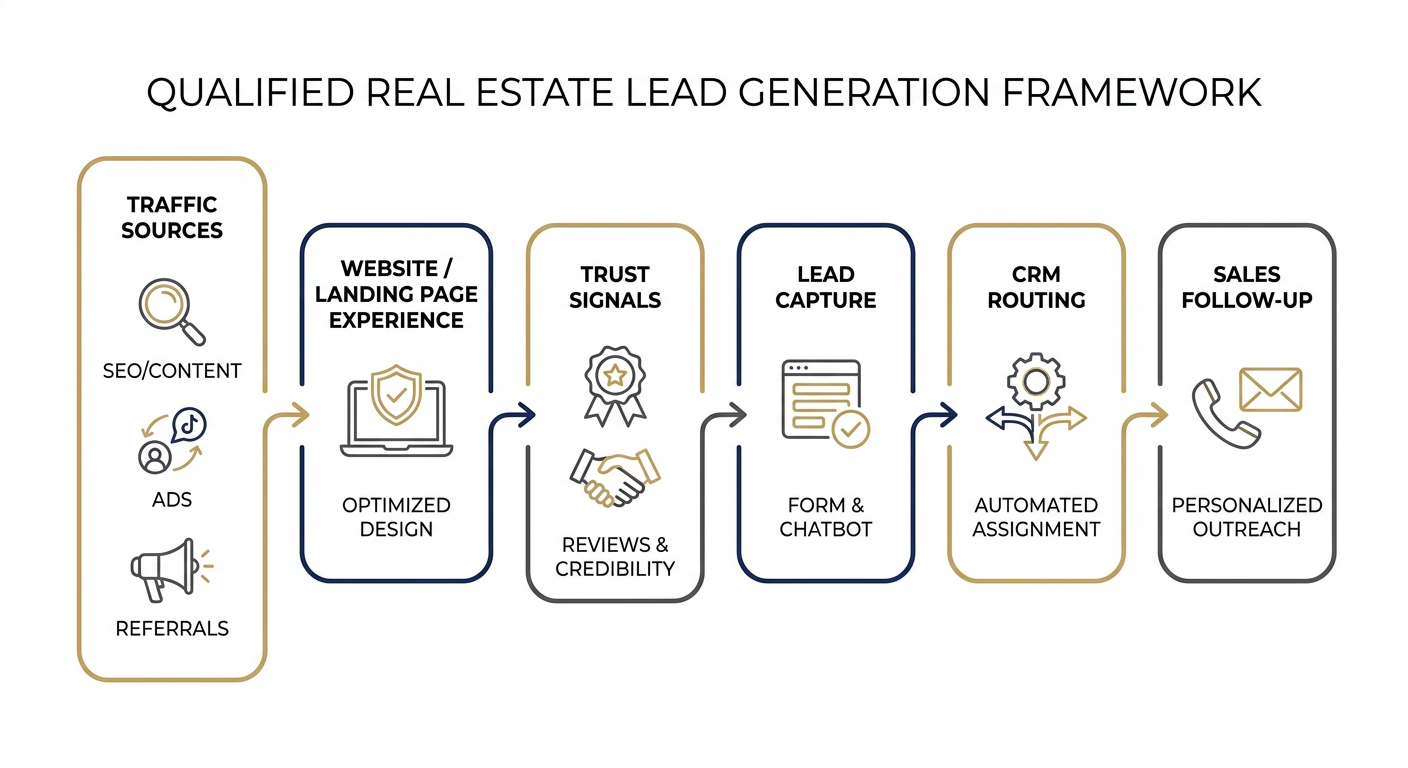
The strongest developer lead generation systems usually contain four connected layers.
1. Positioning and brand clarity
A weak brand attracts weaker attention. If the market does not understand what kind of developer you are, what kind of project you are launching, and why it matters, campaigns have to work harder to compensate.
That is why a strong branding foundation matters first. MARKETIKA’s real estate developer branding blueprint is useful here because it shows how positioning, identity, and project story shape every later conversion touchpoint.
That is why a strong branding foundation matters first. MARKETIKA’s real estate developer branding blueprint is useful here because it shows how positioning, identity, and project story shape every later conversion touchpoint.
2. Traffic acquisition
Traffic can come from search, paid social, content, referral ecosystems, portals, broker networks, and direct brand demand. The right mix depends on the project, market, and stage.
What matters is not just reach. It is fit. Good traffic acquisition brings in audiences whose needs align with the project’s actual value proposition.
3. Website and landing page conversion
Once the visitor arrives, the website has to do real commercial work. It needs to clarify the offer, explain the project, create trust, and guide the user toward the next step.
This is why MARKETIKA’s project portfolio and real estate expertise matter as references. The strongest digital experiences combine story, design, and lead capture rather than treating them as separate pieces.
4. CRM routing and follow-up
The moment after the lead arrives is often where value is lost. Routing, source tagging, assignment logic, and follow-up structure determine whether the lead becomes a conversation or simply sits in a database.
If the website and CRM are disconnected, the developer ends up paying for interest that nobody owns properly.
What improves lead quality, not just lead volume
Lead quality improves when the right message meets the right audience inside the right digital experience.
Clearer targeting
A campaign aimed at investors should not speak the same way as one aimed at owner-occupiers, family buyers, or brokers. Lead generation becomes stronger when message hierarchy reflects actual audience priorities.
Stronger trust signals
The more expensive and complex the product, the more the visitor needs reassurance. Trust signals can include developer credibility, stronger project storytelling, better visual consistency, and a more professional digital environment.
Better website structure
A good website improves qualification because it explains more before the form. Visitors who understand the value, location logic, and offer are more likely to enquire with real intent.
More intelligent form strategy
Sometimes fewer fields convert better. Sometimes stronger pre-qualification questions improve sales efficiency. The right balance depends on the campaign objective and the project’s commercial stage.
Better follow-up design
Lead quality is not purely a media issue. A weak response process can make decent leads look poor. This is one reason Salesforce’s reporting on operational bottlenecks is so relevant for developers managing complex launch workflows.
Which website features support stronger lead generation
A high-converting project website usually supports lead generation through a few core design decisions.
A clear first screen
Visitors should understand the project quickly, including what it is, why it matters, and what step they should take next.
Product clarity
Layouts, amenities, location context, timeline information, and visual explanation all reduce uncertainty. The less abstract the offer feels, the easier it becomes for a serious prospect to move forward.
Trust-oriented content structure
Sections should answer real questions, not simply fill space. The best websites feel useful, not overloaded.
CTA hierarchy
Good lead generation does not rely on one aggressive form. It provides natural conversion points, such as request pricing, download brochure, register interest, or schedule a presentation.
CRM-connected capture
Lead capture should route into a system that preserves source, context, and next-step logic. Otherwise, the website is only collecting names rather than supporting sales.
For a deeper look at the website side of this equation, MARKETIKA’s web design service perspective adds broader context on how performance, structure, and user experience should work together.
How paid media and landing pages should work together
Paid media does not perform well when the click lands in a weak environment. Ads create intent. The landing experience has to deepen it.
That means:
- message match between ad and page
- clear continuity from campaign promise to page structure
- faster access to relevant project details
- a premium visual experience that supports the target audience
- lead capture that feels timely, not forced
This is especially important for developers launching premium or pre-construction projects, where the buyer often needs more reassurance before taking action.
What happens after the lead enters the CRM
The real test of lead generation often starts after the form is submitted.
A connected workflow should include:
- source tagging by channel and campaign
- assignment rules based on project, market, or lead type
- fast response standards
- context for sales teams so the conversation starts with intelligence, not guesswork
- follow-up logic for leads that are interested but not yet ready
Salesforce’s 2026 reporting is useful here because it reinforces how much productivity is lost to fragmented systems and manual bottlenecks. For developers, that is not just an operational problem. It is a revenue problem.
Key metrics developers should track
Lead generation becomes more useful when it is measured beyond cost per lead alone.
Track:
- traffic by source and campaign
- conversion rate from visitor to enquiry
- cost per qualified lead
- speed to lead
- meeting or presentation rate
- lead-to-opportunity rate
- lead-to-reservation or lead-to-sale progression where available
The point is not to track everything. It is to track the few numbers that reveal where trust, friction, or follow-up are helping or hurting performance.
How this looks in practice
A useful way to think about this is through a project such as Velos Residence, where premium digital presentation can support lead capture more effectively than a generic project page. Similarly, Evolutions is relevant as a reference for how a clearer digital and brand environment can better support acquisition and conversion logic.
The lesson is that lead generation improves when the buyer journey feels designed, not improvised.
FAQ
What improves lead generation the most for developers?
Usually the biggest gains come from better positioning, stronger message match between ads and landing pages, clearer website structure, and faster CRM-connected follow-up.
Is a website really that important for lead quality?
Yes. The website shapes trust and clarity before the form submission. A weak website can make a good campaign underperform.
Should lead generation strategy change by geography?
Yes. Language, buyer expectations, and market norms differ. In Canada, terms like pre-construction and presale are often more natural than off-plan. In UAE and GCC contexts, off-plan is more standard. The right terminology should reflect the market.
How can MARKETIKA help?
MARKETIKA can connect branding, web design, visualization, paid acquisition, and CRM-aware conversion thinking into one system built for real estate developers rather than isolated tactics.
Final takeaway
Lead generation for real estate developers works best when websites, ads, CRM routing, and follow-up are designed as one connected system. When those layers are aligned, the developer is not simply generating more enquiries. They are generating better enquiries and creating a smoother path from interest to qualified conversation.
For developers, that alignment is what turns digital marketing into a commercial advantage instead of a noisy expense.