


If every competing development is described as luxury, then luxury alone does not explain why a buyer should choose yours.
That is the core problem many premium real estate launches still struggle with. The project may be high-end, the architecture may be strong, the materials may be expensive, and the target audience may genuinely sit in the luxury segment, yet the marketing still sounds interchangeable.
The issue is not that the word luxury is wrong.
The issue is that it is incomplete.
Luxury is a category. It helps place the project in the market. But it does not by itself answer the question that really matters: why this high-end development instead of another one?
Category explains where the project sits
The word luxury can still be useful.
It can signal price positioning, audience level, service expectation, design ambition, or product class. Buyers need that orientation.
But that kind of category language usually describes what buyers already expect in the segment:
- quality finishes
- strong amenities
- better design
- more service
- desirable location
Those expectations may be necessary, but they are rarely enough to create preference.
That is why MARKETIKA's real estate developer branding blueprint begins with positioning rather than aesthetics alone. Before the market can remember the brand, it needs a sharper reason to care.
Positioning answers a different question
If category says, "This is premium," positioning says, "This is the kind of premium experience or ownership logic we are offering, and this is why it matters to you."
That distinction is crucial.
Positioning might come from:
- privacy and low density
- a hospitality-style service model
- architecture-led living
- waterfront scarcity
- wellness-focused planning
- family-oriented design logic
- branded-residence credibility
- investment resilience in a specific micro-market
These are not just features. They are ways of framing the value so the right buyer can recognize themselves inside the story.
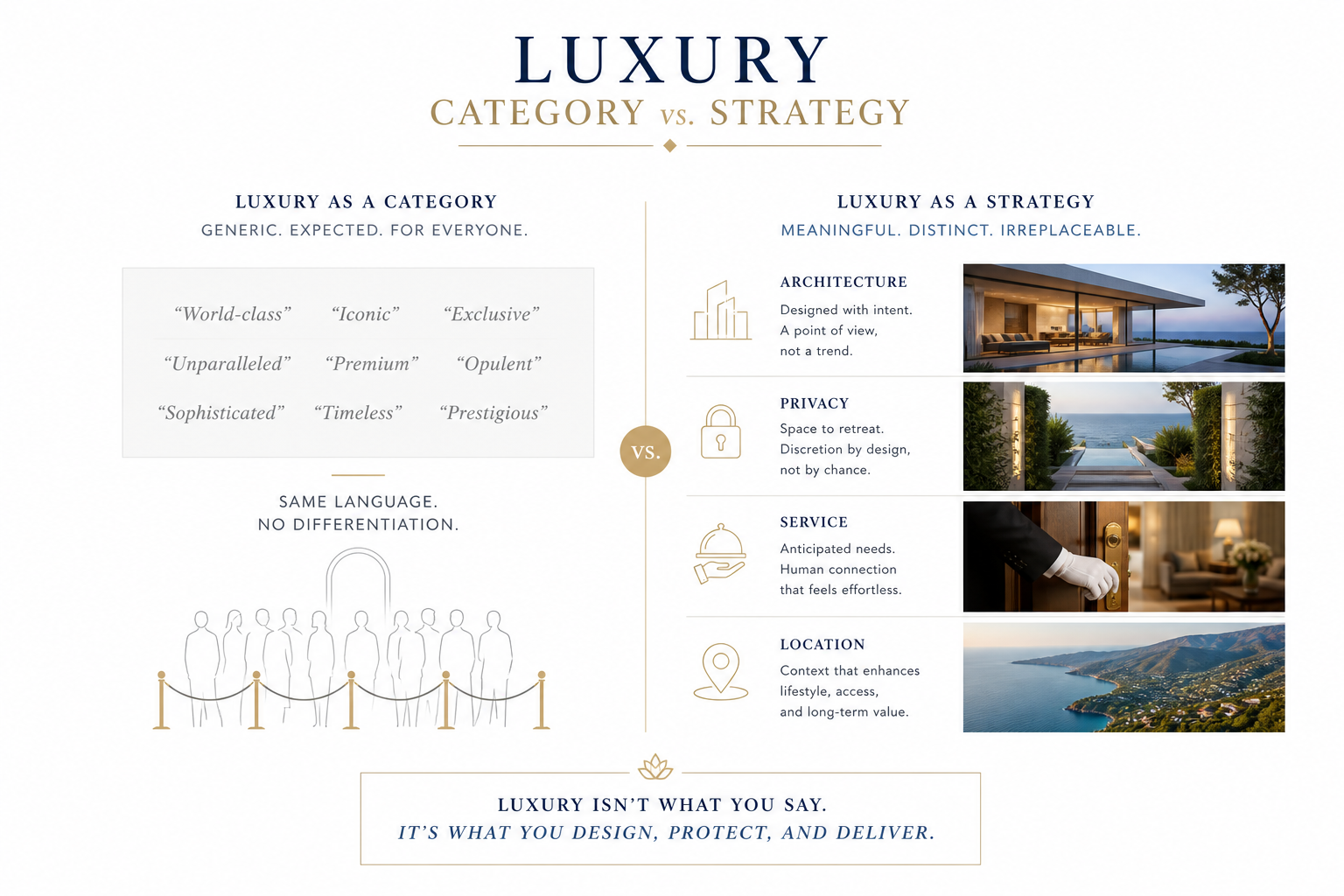
Why generic luxury language weakens differentiation
The problem with phrases such as premium finishes, exceptional lifestyle, and world-class amenities is not that they are false.
It is that they are easy for everyone else to say too.
When five nearby launches use the same adjectives, the audience still needs a reason to believe one project deserves attention over the others. Without that reason, the campaign may look elegant while remaining strategically vague.
This is where proof-based marketing for developers becomes more persuasive than generic language. Specificity always travels better than abstraction.
Features still matter, but they need meaning
The answer is not to stop talking about location, design, materials, or amenities.
Those things matter deeply.
The real task is to connect them to buyer significance.
This is the point where category language becomes strategy.
Positioning helps every touchpoint work harder
When the positioning is clearer, the whole launch becomes easier to build.
The website becomes more focused. The visual system feels more deliberate. The copy sounds less generic. Sales teams explain the project more consistently. Brokers know what makes the offer meaningful.
This is also why MARKETIKA's project portfolio and developer-focused expertise pages matter as references. Strong launches usually feel coherent because the positioning logic is carrying through the website, visuals, and conversion path together.
Questions developers should answer before launch
To avoid generic luxury positioning, teams should be able to answer:
- Who is this project really for?
- What kind of premium experience or ownership logic are we selling?
- What proof makes that positioning credible?
- Which competitor are we clearly not trying to imitate?
- What should buyers remember after one minute on the site?
If those answers are fuzzy, luxury will remain a label rather than a strategy.
Final takeaway
Luxury gets a project into the category.
Positioning gives buyers a reason to choose it.
Developers who understand that distinction create marketing that feels more specific, more memorable, and more commercially persuasive. The market does not only need to know that the project is high-end. It needs to know why this version of high-end deserves belief.


