



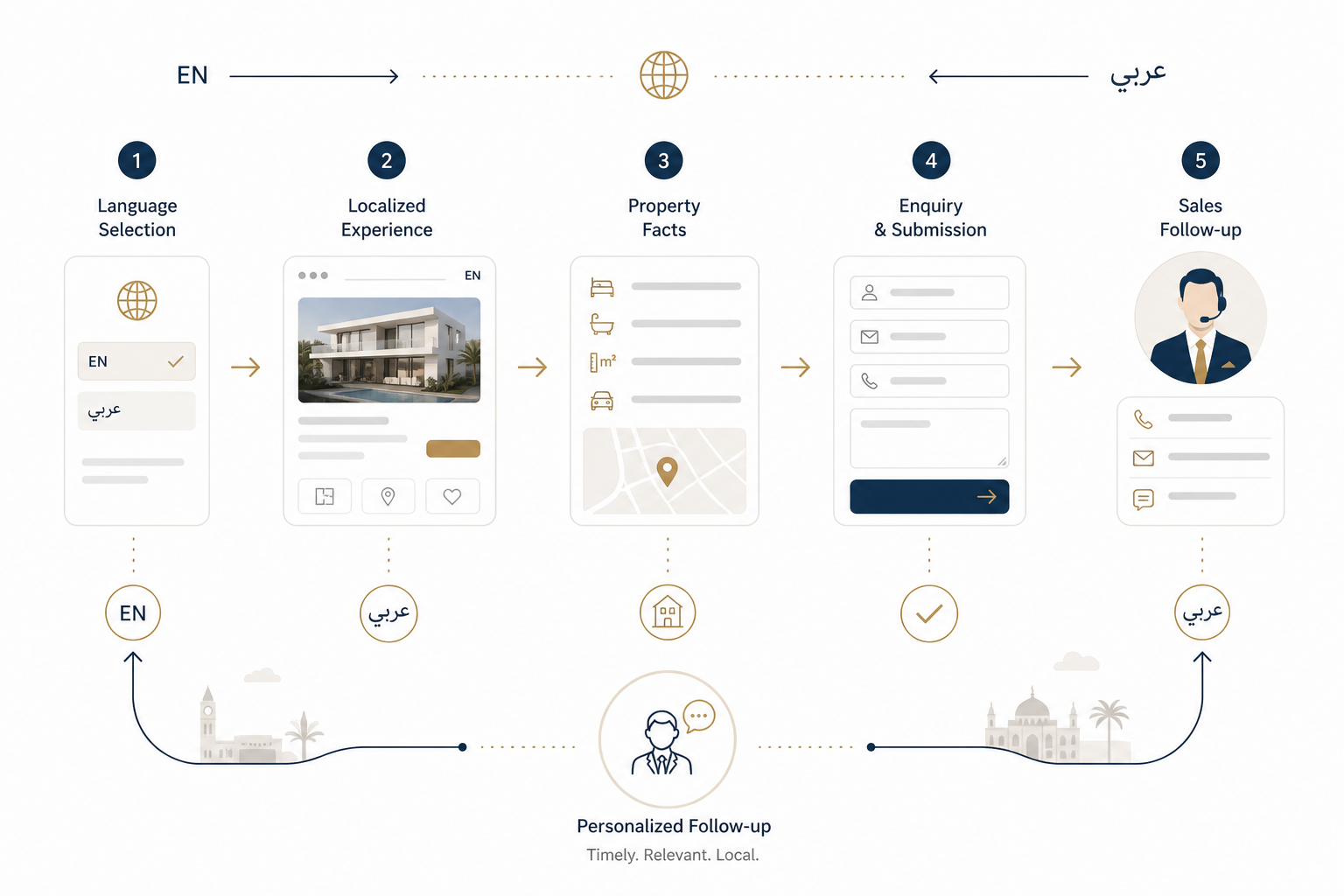
Direct answer: A multilingual real estate website should treat every language as a complete buyer experience, not as translated copy layered onto one English site. Navigation, property facts, floorplans, downloadable documents, forms, confirmation messages, search signals, and sales follow-up must remain consistent across languages.
This matters most for international developments in markets such as the UAE, the USA, and Canada. A buyer may enter through an Arabic, French, Chinese, or Russian campaign, compare several units, download a payment plan, and submit a form without ever switching back to English. If one part of that journey breaks, the buyer does not experience a small translation error. They experience uncertainty about the project itself.
Multilingual delivery is therefore a product, design, content, and operations problem at the same time. The best-performing sites plan the experience before the copy is translated.
Translation is only one layer of localization
Translation changes the words. Localization adapts the experience to the language, market, and decision context of the person using it.
For a property website, localization may affect:
- Currency, area units, dates, phone formats, and address fields
- The way legal, financing, and ownership information is explained
- The order and density of navigation items
- The direction of layouts for right-to-left languages
- The imagery, examples, and tone used for different markets
- The language and response time of sales follow-up
A page can be grammatically correct and still feel unfinished if the form confirmation is in English, the brochure downloads in another language, or the buyer is sent to a sales representative who cannot continue the conversation. The goal is not to make every version identical. The goal is to make each version feel intentional and trustworthy.
Define the language and market matrix first
Before planning templates, list the audiences the project is genuinely prepared to serve. “International” is not a content plan. Identify languages, target markets, buyer types, legal constraints, available sales coverage, and the assets required for each version.
A useful matrix might distinguish:
- Language: English, Arabic, French, Mandarin, Russian, or another priority language.
- Market: UAE, Canada, the United States, or a specific international region.
- Buyer intent: end user, investor, second-home purchaser, broker, or family office.
- Commercial differences: currency, payment plan, taxes, ownership rules, and available inventory.
- Operational owner: the person responsible for translation, updates, lead routing, and quality assurance.
This prevents a common failure mode: launching five language switches with only two maintained properly. Fewer complete languages are usually better than many partial ones.
Make page parity a non-negotiable standard
Every important buyer action should work in every supported language. Create a page-parity checklist for the property overview, residences, amenities, location, developer, payment information, FAQs, contact flow, and legal documents.
Check more than the visible paragraphs. Review:
- Menu items, breadcrumbs, buttons, filters, and validation messages
- Floorplan labels, unit selectors, map pins, captions, and image alt text
- Brochures, payment plans, specification sheets, and privacy notices
- Form fields, consent copy, confirmation screens, and email notifications
- Chat, phone, WhatsApp, calendar booking, and sales handoff messages
- Empty states, error states, loading states, and unavailable inventory messages
The buyer should not be forced to guess which language version contains the missing information. If a document cannot be translated yet, say so clearly and provide a useful alternative. Silent switching is what makes a site feel broken.
Design for Arabic and other right-to-left languages from the start
Arabic is not simply English with different words. It changes direction, alignment, text length, line breaks, icon placement, tables, forms, and the way mixed Arabic and Latin text is read.
The W3C guidance on structural markup and right-to-left text recommends setting the document direction explicitly for RTL pages and using logical layout properties such as start and end instead of hard-coding left and right. That principle belongs in the design system, not in a last-minute patch.
Plan for:
- RTL navigation and mirrored page composition where appropriate
- Buttons and arrows that communicate direction correctly
- Number, price, unit, and phone formatting in mixed scripts
- Headline lengths that expand or contract without breaking the layout
- Fonts that support the language clearly at every screen size
- Tables, floorplans, and comparison controls that remain understandable
- Forms that accept both Arabic and Latin input without awkward cursor behavior
The W3C language declaration guidance also distinguishes language from direction. A page should declare its language and its writing direction separately. This helps browsers, assistive technologies, and interface logic interpret the content correctly.
Treat property materials as part of the interface
A multilingual website is only as complete as its downloadable and interactive materials. A translated landing page paired with an English-only payment plan creates a credibility gap at exactly the moment the buyer is evaluating seriousness.
Create a document inventory before launch. For each asset, record the source version, translated version, approval owner, publication date, and expiry or replacement rule. Keep naming consistent so buyers and sales teams can identify the current file.
Floorplans require special care. Room names, dimensions, legends, orientation, and furniture symbols should be checked by someone who understands the target language and the property product. Legal and financial documents need professional review, not only machine translation. If regional rules differ, use separate market-specific documents rather than implying that one file applies everywhere.
Build search visibility into the information architecture
Language versions need stable, discoverable URLs and a clear relationship to one another. Google recommends using `hreflang` annotations, HTTP headers, or sitemaps to signal localized alternatives, with each version listing itself and the other relevant versions. See Google Search Central's documentation on localized versions.
The implementation method can vary, but the operating principle is consistent:
- Give each language or locale a durable URL.
- Use accurate language and region codes.
- Keep alternate references reciprocal.
- Provide a fallback for users whose language is not supported.
- Keep canonical and internal-link decisions consistent.
- Localize page titles, descriptions, headings, and meaningful URL paths.
- Include important PDFs and downloadable assets in the localization plan.
Do not assume that a language selector alone solves international search. Google notes that its systems determine page language algorithmically, while explicit alternate-page signals help it understand the relationship between versions. The site still needs useful, indexable, people-first content in each language.
For a wider overview of useful content, descriptive URLs, links, and search-friendly organization, use Google's SEO Starter Guide as a technical reference.
Connect language choice to lead routing
The language selected on the site should become useful information for the sales process. Pass it to the CRM with the source URL, campaign, market, property interest, and consent record. The sales team should know whether a lead browsed the Arabic version, downloaded a French brochure, or requested a Mandarin consultation.
Define the handoff before launch:
- Capture the language and market as structured lead data.
- Route the enquiry to a representative who can respond in that language, or state the available response language honestly.
- Use localized confirmation messages and response templates.
- Keep the conversation in the buyer's chosen language unless they request a change.
- Record unanswered language demand so the next content investment is based on evidence.
A beautiful multilingual website that sends every lead into one English-only inbox has localized the front door but not the business.

Use a translation workflow that can survive project updates
Real estate websites change frequently. Inventory, prices, construction milestones, brochures, amenities, and legal information are updated throughout a launch. A translation process that works once may fail six weeks later.
Connect source content to a controlled workflow. Store translations in a system where the team can see what changed, who approved it, and which language versions are affected. Separate reusable interface strings from editorial content and regulated documents. Use translation memory or machine assistance where it improves speed, but require human review for high-value sales copy, legal information, and culturally sensitive claims.
Set a release rule: no English update is complete until the team decides whether the change needs translation, whether the old version should remain visible, and whether a language-specific campaign link must be updated. This keeps versions aligned without slowing every small interface change.
Test with real buyer tasks, not only proofreading
Language QA should include native or highly proficient reviewers, but proofreading is only one part of the test. Ask reviewers to complete realistic tasks on desktop and mobile:
- Find a two-bedroom residence and understand its key facts.
- Compare two floorplans and download the correct brochure.
- Submit an enquiry using a local phone format.
- Change languages and return to the same property.
- Read a fee or payment explanation without switching languages.
- Confirm that the sales response preserves the selected language.
Test slow connections, small screens, long names, missing translations, mixed-script text, and form errors. Use screenshots and a defect log so the development team can reproduce problems. After launch, review analytics by language for completion rate, form errors, engagement with documents, and qualified enquiry rate.
MARKETIKA's web, sales, visual, and interactive expertise for real estate developers reflects this joined-up approach. Its project work also shows why visual tools and sales content need to be considered together. The broader MARKETIKA strategy, web, and social practice can support the campaign layer around the website, but the language experience must remain consistent wherever a buyer enters.
FAQ
Should every project support multiple languages?
Only when the project has a meaningful audience, sales capacity, and maintenance plan for each language. Start with the markets the developer can serve well, then expand using demand and lead-quality data.
Is automatic translation enough?
It can support internal drafts and speed up repetitive work, but buyer-facing property copy, legal information, payment details, and high-value claims should be professionally reviewed.
Should each language have its own URL?
In most cases, yes. Stable URLs make the experience easier to share, measure, maintain, and understand. The exact structure can be a subdirectory, subdomain, or separate domain, as long as the architecture is consistent and correctly connected.
Does Arabic require a separate website?
Not necessarily. It requires a deliberate RTL design system, appropriate language handling, suitable content, and thorough testing. A well-built content system can support Arabic and LTR languages within one platform.
Final takeaway
A multilingual real estate website succeeds when the buyer can move from discovery to decision without noticing where translation, design, technology, or sales operations begin and end. Plan the language matrix, maintain page parity, design for direction and content length, connect language to lead routing, and test real buyer tasks. The result should feel as though the project was designed for that audience from the beginning.


