


Off-plan is no longer a side bet in Dubai and other global hubs. In 2023, off-plan deals made up around half of all residential transactions in Dubai, with Property Finder and Betterhomes both reporting that off-plan crossed the 50 percent mark in their annual market reports. For developers in the UAE, KSA, USA, and Canada, that means one thing: your launch is won or lost long before handover.
This framework is written for developers, marketing directors, and sales leaders who want a repeatable pre-launch system, not just another campaign. It combines what is working in Dubai, lessons from North American presales, and Marketika experience as a specialized digital marketing, branding, design, and visualization agency for real estate developers across these regions.
This framework is written for developers, marketing directors, and sales leaders who want a repeatable pre-launch system, not just another campaign. It combines what is working in Dubai, lessons from North American presales, and Marketika experience as a specialized digital marketing, branding, design, and visualization agency for real estate developers across these regions.
1. Why modern off-plan launches are decided before handover
For buyers and investors, three forces now shape off-plan behavior:
- Inventory is increasingly global. A buyer in Riyadh or Toronto is comparing your project with Dubai waterfront stock and branded residences worldwide.
- Information is radically transparent. Portals, social feeds, and third party data providers make pricing, absorption, and reputation easy to compare.
- Decision making is remote first. A large share of reservations are now made without a single physical visit, especially in Dubai and KSA.
The result: confidence must be built digitally, months before launch day. That confidence comes from a structured pre-launch funnel, not just a good brochure.
2. Start with the asset, audience, and pricing logic
Before any media spend, clarify three things.
Asset definition
- What exact story is this project telling in its city or community context?
- Which value drivers matter most: waterfront, schools, branded operator, short term rental yield, lifestyle positioning?
- How does the product compare to the last 3 to 5 launches your target buyers saw?
Document this in a short internal narrative that the whole team can repeat. If you need inspiration on how to frame a development in a competitive market, study the Real Estate Developer Branding Blueprint from Marketika: Real Estate Developer Branding Blueprint.
Audience clarity by region
Different regions respond to different proof points.
- UAE and KSA: offshore investors from Europe and Asia, high share of cash buyers, sensitivity to community brand, yield, and exit liquidity.
- USA: local end users and move-up buyers by submarket, financing constraints, focus on school districts and commute.
- Canada: mix of end users and investors, tighter mortgage environments, strong focus on stability and renter demand.
Define 2 to 3 primary personas and map what each must see to reserve confidently.
Pricing logic
Pricing is a story, not only a spreadsheet. Buyers will compare you against:
- Most recent comparable launches
- Resale inventory in nearby projects
- Rental yields and service charge levels
Your pre-launch content should repeatedly justify pricing with clear visuals and explanations: location, amenities, architectural character, and digital experiences.
3. Design a pre-launch funnel, not a single campaign
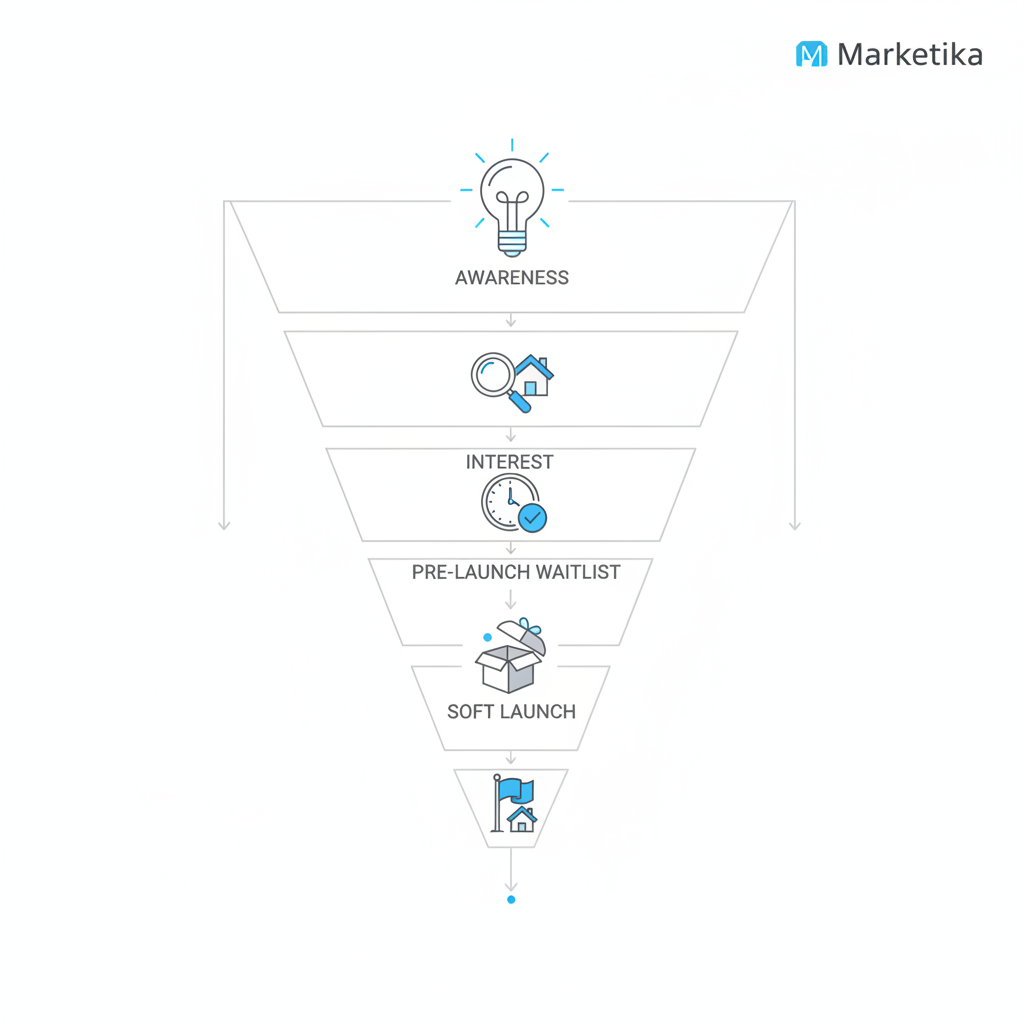
The most reliable launches follow a staged funnel. A simple working model:
- Awareness
- Interest
- Pre-launch waitlist
- Soft launch
- Public launch
Awareness
Objectives:
- Make the right audience aware something is coming in this micro location.
- Associate the project with 1 to 2 memorable positioning ideas (for example, family waterfront living, branded hotel residences, or smart rental product).
Tactics:
- Lightweight teaser creatives on portals and social
- Short teaser video cut from early CGI or moodboards
- PR and founder interviews hinting at the project
Interest
At this stage you are collecting early hand-raisers.
- Landing page or microsite with lead form and clear value promise
- Basic CGI or mood visuals to establish quality
- Clear timeline: when pricing is released, what buyers can expect next
Pre-launch waitlist
This is where serious intent is separated from casual curiosity.
- More detailed project story: unit mix, amenities, early views of masterplan
- Lead magnets such as early access to inventory, better payment plans, or priority selection windows
- Strong follow up through email, WhatsApp, and brokers
Soft launch
Soft launch is where early pricing is tested and the first reservations are taken.
- Priority outreach to the waitlist and key brokers
- More detailed CGI, interior renders, and amenity visuals
- Early social proof: first reservations, testimonials from trusted brokers or advisers
Public launch
Finally, you open to the wider market with clear urgency.
- Full portal presence with rich media
- Performance campaigns across Meta, Google, YouTube
- Retargeting sequences for all previous touchpoints
A strong pre-launch framework allows you to intensify or extend each phase without rebuilding the system every time.
4. Channel mix by region
The framework stays constant, but the mix changes by geography.
UAE and KSA
- Real estate portals such as Property Finder, Bayut, and locally relevant platforms are often the first discovery point.
- WhatsApp is a primary sales channel, used for quick follow up, voice notes, and document sharing.
- Broker networks are extremely powerful, especially for off-plan stock.
Dubai data from Property Finder and Betterhomes shows how powerful off-plan has become, with off-plan transactions representing just over half of all sales in 2023. That level of competition means creative, messaging, and speed of follow up must all be above average.
USA
- Search, local SEO, and Google Maps presence around the project and developer brand.
- Paid social retargeting layered on top of organic discovery.
- Portals like Zillow and Realtor.com to complement your own project site.
Here, financing, school districts, and commute times are often leading decision drivers. Your content should integrate these into visuals and copy, not bury them in PDFs.
Canada
- Strong use of broker networks and presale focused agencies in markets like Vancouver and Toronto.
- Emphasis on rental demand, absorption data, and long term neighborhood plans.
In all regions, your own project microsite becomes the single truthful source that all channels point to.
5. Build a coherent creative and CGI system
High performing launches treat creative and CGI as a system, not a folder of assets.
Key ingredients:
- Master brand narrative and visual language for the project
- Exterior CGI showing massing, context, and atmosphere across day and night
- Interior CGI and amenity visuals that show how people will actually live
- Short motion clips cut from CGI sequences for social and ad use
- A responsive, mobile first microsite that ties it all together
Case studies from 3D visualization providers like Nvision Studios and PropertyRender show that listings using high quality CGI and 3D assets can sell faster, achieve higher offer values, and attract more inquiries than static photography alone. For developers, that translates into shorter sales cycles and more pricing power.
This is where a specialist partner like Marketika can help connect CGI, branding, and digital funnels into one plan rather than a set of disconnected deliverables. You can see examples of this combined approach in the Marketika projects portfolio.
This is where a specialist partner like Marketika can help connect CGI, branding, and digital funnels into one plan rather than a set of disconnected deliverables. You can see examples of this combined approach in the Marketika projects portfolio.
6. Sales enablement for pre-launch
A sophisticated funnel fails if sales teams do not have the right tools.
Make sure that for each phase:
- Sales and broker teams have updated decks that match the latest CGI and pricing.
- Scripts and objection handling guides are aligned with the main narrative.
- Lead routing is clear: who calls which segment, in which timeframe, with which follow up message.
- WhatsApp templates, email sequences, and calendar links are all pre-configured.
The goal is simple: when a lead moves from ad to form to human contact, the story should feel seamless.
7. Tracking, benchmarks, and learning between launches
Treat every launch as a data collection exercise.
Track by funnel stage:
- Awareness: impressions, click through rates, cost per qualified site visit
- Interest: landing page conversion rate and cost per high intent lead
- Waitlist: percentage of leads who opt in for early access
- Soft launch: reservation rate, speed of decision, and pricing feedback
- Public launch: sell out velocity and discounting behavior
Use each project to refine your benchmarks by region and product type. Over time, your organization should know roughly how many quality leads are required per unit sold, and what media mix tends to deliver them.
8. How Marketika plugs into this framework
Marketika works specifically with real estate developers in the USA, Canada, UAE, and KSA on branding, digital marketing, and visualization. That focus means we are used to stitching together CGI, portals, paid media, microsites, and sales enablement into one clean launch system.
If you want to see how other developers structure their digital presence and creative systems, explore the Marketika expertise overview and recent insights for developers.
If you want to see how other developers structure their digital presence and creative systems, explore the Marketika expertise overview and recent insights for developers.
Next step
For your next off-plan launch, start by mapping your current efforts against this framework. Identify where the gaps are in asset clarity, funnel stages, or sales enablement, then design one integrated plan rather than separate marketing, CGI, and sales initiatives.