



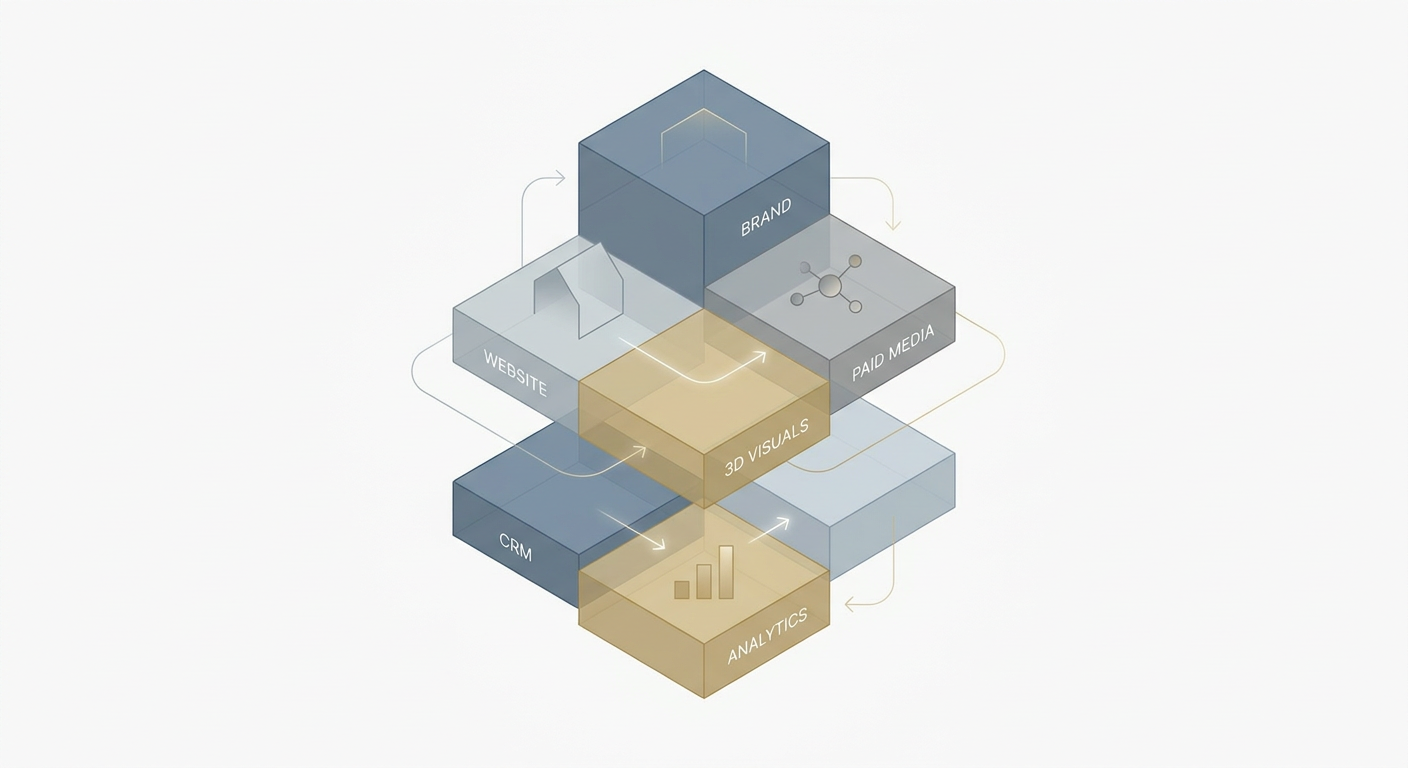
A strong real estate developer marketing strategy is not a campaign plan in isolation. It is the system that connects positioning, website experience, visual storytelling, paid acquisition, lead management, and reporting so a project can move from attention to qualified demand with less waste.
That matters because the buyer journey is now digital long before a sales call happens. Statista projects digital advertising to account for 82.2% of global ad investment in 2025, which shows how strongly attention has shifted online. At the same time, the National Association of REALTORS reports that 70% of buyers used a mobile or tablet device in their home search, reinforcing how much real estate discovery and comparison now happen through digital channels rather than sales-led conversations alone. Sources: Statista digital advertising outlook, NAR 2025 Profile of Home Buyers and Sellers.
For developers in the UAE, USA, and Canada, the implication is straightforward. Better results usually do not come from doing more marketing activities. They come from making the core activities work together.
What a real estate developer marketing strategy actually includes
A real estate developer marketing strategy should answer five practical questions:
- Who is the project really for?
- Why should that audience trust it?
- Where will they discover it?
- What digital experience will move them forward?
- How will marketing and sales measure whether the system is working?
That is why strategy should sit above channels. Search, social, portals, email, CGI, websites, landing pages, CRM routing, and analytics all matter, but they only perform well when they are aligned to one commercial logic.
Why many developer campaigns underperform
Many developers do not have a visibility problem. They have a coordination problem.
Common breakdowns look like this:
- the campaign message sounds premium, but the landing page feels generic
- the website looks polished, but it does not explain the project clearly
- the visuals generate interest, but lead capture collects too little context
- sales receives enquiries, but routing and follow-up are inconsistent
- reporting focuses on lead volume, not qualified demand or progression
When those disconnects stack up, marketing can appear busy while commercial performance stays unpredictable.
The 6-part system behind a stronger launch
1. Positioning before promotion
Every launch should begin with sharper positioning, not media buying.
That means defining:
- the primary buyer or investor profile
- the project category and price logic
- the emotional promise behind the development
- the practical proof behind that promise
- the market context that makes the project relevant now
This is where branding matters. A project should not sound like every other development in its category. The strongest developer brands create trust before the sales team enters the conversation by making the offer easier to understand and easier to remember.
For a useful benchmark, MARKETIKA’s real estate developer branding perspective and broader expertise across branding, websites, 3D, and digital strategy show how positioning becomes more effective when brand, UX, and conversion thinking are planned together.
2. A website that sells the logic, not only the look
A real estate website should do more than display renders. It should reduce uncertainty.
That means the digital experience needs to answer questions such as:
- What is the project, clearly and quickly?
- Who is it for?
- Why is the location or product mix compelling?
- What should the user do next?
This is why website structure matters as much as visual quality. Public examples such as Evolutions and Quatrimmo Vision show how developers can use stronger narrative sequencing, calmer design, and clearer framing to support premium perception online.
3. Visual assets that help buyers trust what is not built yet
For off-plan projects in the UAE, and for many pre-construction projects in the USA and Canada, buyers often need to commit before they can physically experience the final product.
That makes high-quality visual assets commercially important, not decorative.
Useful assets often include:
- featured CGI renders for campaigns and launch pages
- floorplans and unit comparison tools
- short-form video or animation for paid media
- virtual tours or 3D experiences for higher-consideration stages
- amenity, location, and lifestyle visuals that explain context rather than only mood
A strong marketing strategy decides where each asset belongs in the funnel. Some visuals attract attention. Others reduce hesitation. The point is not maximum production volume. It is better commercial sequencing.
4. Channel mix based on market behavior
The right channel mix depends on geography, product type, and buyer intent.
UAE
In the UAE, especially in Dubai, off-plan demand often depends on high-speed visibility, investor confidence, and digitally persuasive presentation. Paid social, search, portals, remarketing, and polished launch microsites usually work best when they operate as one coordinated system.
USA
In the USA, developers often need stronger local search intent capture, clearer project education, and better alignment between project marketing, brokerage activity, and conversion paths. Search campaigns, project pages, content, and strong sales follow-up are often more important than visual reach alone.
Canada
In Canada, pre-construction marketing usually benefits from clarity, trust, and a lower-noise educational approach. Buyers tend to compare more carefully, so websites, email nurturing, product explanation, and transparent lead follow-up become especially important.
This is where a broader creative campaign perspective from MARKETIKA can support the reader journey as well. Developer marketing works better when branding, content, advertising, and digital experience are planned as one commercial environment rather than handed off between disconnected specialists.
5. Lead handling as part of the strategy
A marketing system is only as strong as the handoff into sales.
Developers often underestimate how much value is lost after the form fill. A stronger lead-management layer usually includes:
- source and campaign tracking
- basic intent context attached to each enquiry
- routing rules by project, language, or market
- fast first response
- structured follow-up rather than ad hoc chasing
This is one reason a modern strategy should be CRM-aware from the beginning. If the team cannot connect demand generation to lead quality and follow-up speed, it becomes difficult to know which marketing investments are genuinely working.
6. Measurement that goes beyond cost per lead
Cost per lead alone is too weak for developer decision-making.
A more useful performance view usually tracks:
- traffic quality by source
- landing page conversion rate
- cost per qualified lead
- speed to lead
- viewing, meeting, or call-booking rate
- progression from lead to serious opportunity where available
The best reporting systems make waste visible. They show whether the problem is audience quality, website friction, weak messaging, or poor follow-up.

What developers should prioritize first
If a developer is rebuilding or upgrading their strategy, the most useful order usually looks like this:
- clarify the project position and target audience
- define the website or landing-page journey
- align visuals to the buyer journey, not only brand mood
- select channels based on intent and market behavior
- tighten lead routing and follow-up logic
- build reporting around qualified demand and progression
That order matters because acquisition tends to amplify whatever is already true. If the positioning is weak or the website is confusing, larger media budgets usually increase inefficiency rather than solve it.
Common strategic mistakes to avoid
Treating brand and performance as separate worlds
For developers, brand affects conversion more than many teams assume. Trust, visual consistency, and clarity shape whether a buyer moves forward.
Building the website after media planning
If the conversion path is weak, traffic quality will appear worse than it really is.
Measuring only activity, not progression
Clicks, impressions, and raw lead counts do not explain whether the system is producing commercially useful demand.
Over-relying on one channel
A project that depends entirely on one source of traffic becomes vulnerable quickly, especially during launch periods.
Using generic project language
Terms like premium, iconic, exclusive, or elevated become weak when they are not supported by clear differentiation and proof.
FAQ
Why does marketing strategy matter more than isolated tactics for developers?
Because developers are selling a high-trust, high-consideration product. If brand, website UX, visuals, media, and follow-up do not support one another, demand leaks throughout the funnel.
What should be included in a real estate developer marketing strategy?
At minimum, it should include positioning, website and content structure, visual asset planning, channel mix, lead management logic, and performance measurement.
Does the strategy need to differ by geography?
Yes. UAE off-plan launches, USA project marketing, and Canadian pre-construction campaigns all have different buyer expectations, pacing, and decision triggers.
How can MARKETIKA help?
MARKETIKA can connect real estate developer projects and case references, specialist real estate expertise, and its own marketing guide for real estate developers into a more connected developer growth system that blends brand, website UX, visuals, and demand generation.
Final takeaway
A real estate developer marketing strategy works best when it is built as a connected commercial system. Developers that align positioning, website structure, visuals, acquisition, lead handling, and measurement create better conditions for trust, better lead quality, and more predictable launch performance.
The practical goal is not more marketing noise. It is a clearer path from first impression to serious buyer conversation.