



Direct answer: A standalone project microsite works best when a development needs its own brand, campaign funnel, and focused sales journey. A project page inside the developer website works better when the developer already carries meaningful trust and the launch benefits from portfolio context, shared search authority, and simpler maintenance. A hybrid model can combine both when the roles are clear.
The decision is strategic before it is technical. The right structure depends on how buyers discover the project, how much authority the developer brand contributes, how complex the product is, how long the digital experience must live, and how the sales team will use the site after launch.
A microsite is not automatically more premium, and a page inside the main website is not automatically safer. Each choice creates a different relationship between project brand, developer brand, content, analytics, and long-term governance.
Define the two models clearly
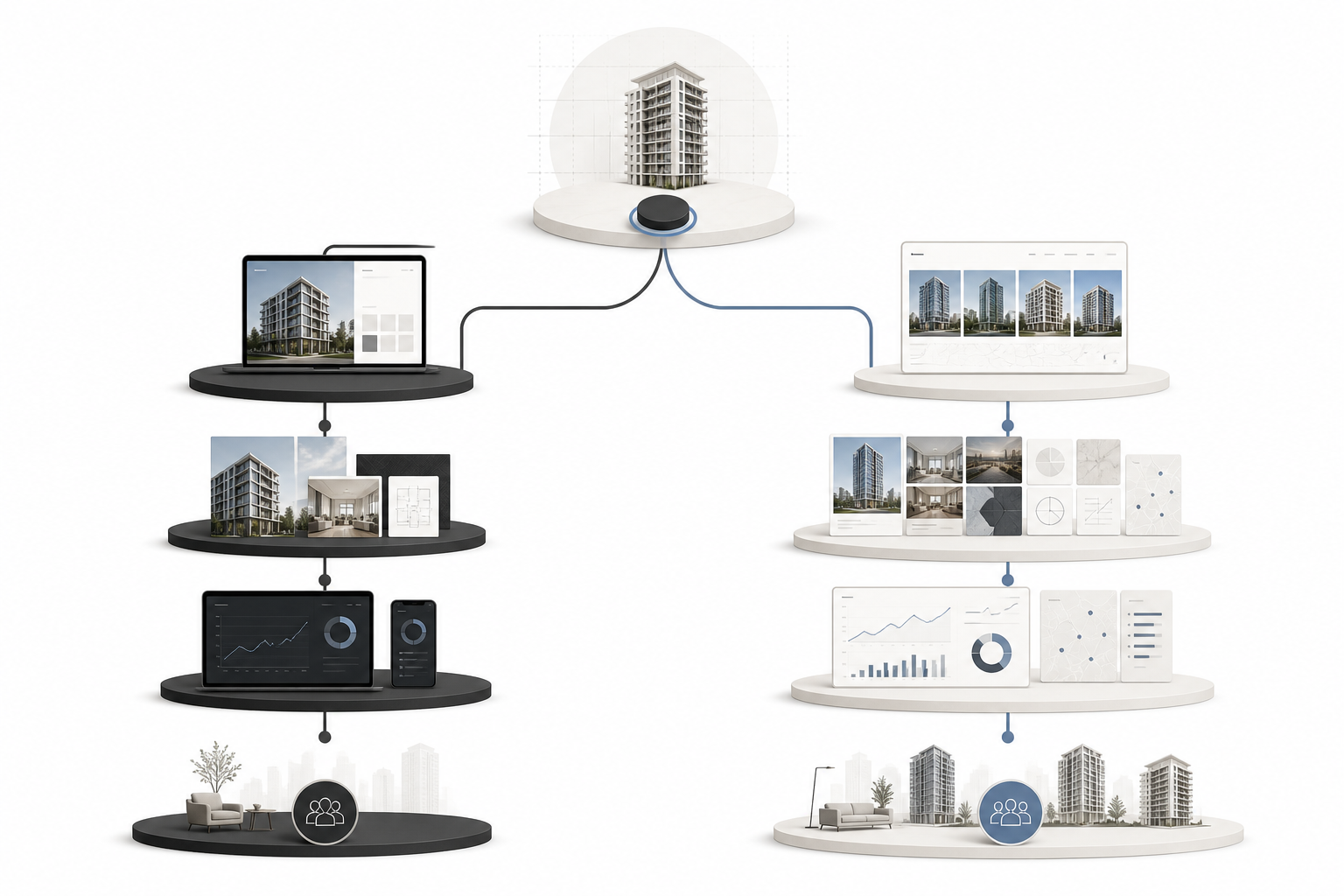
A project microsite is a focused digital experience built around one development or launch. It may live in a subdirectory, subdomain, or separate domain. It usually has a smaller information architecture, a distinct visual system, campaign-specific landing pages, and a direct path to enquiry or appointment.
A developer website structure places the project inside the parent brand's existing domain and navigation. The launch may have a dedicated project section, but it shares the developer's header, footer, design system, technical platform, and broader portfolio context.
The labels matter less than the operating model. A project can feel highly distinctive within a developer website, and a separate microsite can still feel generic if its positioning and experience are weak.
Choose a microsite when the project needs its own market position
A microsite is usually the stronger option when the launch has a clear identity that needs room to breathe.
The project is a destination, not just another listing
A masterplanned community, branded residence, resort, or mixed-use district may require its own story, vocabulary, interactive map, amenity system, and content depth. Putting all of that inside a generic portfolio template can make the project feel smaller than it is.
Paid campaigns need a focused conversion path
If traffic will arrive from multiple paid campaigns, broker links, events, or international markets, a dedicated experience can reduce distraction. Visitors can move from the promise in an advert to the relevant proof, unit selection, brochure, or appointment without browsing unrelated developer content.
The product needs interactive tools
Large inventories, multiple buildings, floorplan comparisons, virtual tours, unit selectors, masterplan maps, and pricing or availability logic often deserve an interface designed around the project. The site becomes a sales environment, not only a company page.
The project has a different audience or geography
A new launch may target international investors, a luxury end user, a local family segment, or a broker network that is different from the developer's usual audience. A dedicated experience can adapt language, content, imagery, and lead routing without forcing every change into the corporate site.
The campaign has a defined life cycle
A microsite makes sense when there is a launch period, sales phase, and post-launch plan. Decide in advance whether it will become a long-term project website, redirect into the portfolio after completion, or remain as an archive and reference point.
Keep the launch within the developer website when trust and continuity matter more
A project page inside the main developer website is often more effective when the parent brand already does important work in the decision.
The developer is the primary reason to believe
If buyers search for the developer first, a project page that sits within the same domain can make it easier to move from corporate credibility to project detail. Track record, delivered communities, leadership, contact information, and other active projects remain one click away.
The project is early-stage or relatively simple
A smaller development may need a clear page, a gallery, specifications, location, FAQs, and an enquiry form, but not a separate operating system. Keeping the experience inside the existing platform reduces duplicated components and makes updates easier.
Long-term search and content consolidation are priorities
A mature developer site may already have relevant links, content, internal navigation, and search visibility. Consolidating project information can help the developer build a stronger topical resource instead of splitting attention across several new domains. This is not an automatic ranking advantage, but it can simplify discovery and maintenance when the content belongs to the same brand system.
The portfolio relationship is part of the proposition
Some buyers want to compare projects, understand the developer's approach, and see evidence of delivery before enquiring. A portfolio context can make the new launch feel more credible, especially for a developer entering a new market.
Use a hybrid model when discovery and conversion need different environments
The hybrid model separates roles without separating the buyer journey. The developer website introduces the company, project, delivery record, and high-level proposition. A deeper project experience handles interactive exploration, campaign traffic, detailed content, and sales tools.
For example, the main site can host a stable project overview at a descriptive path, while a focused experience supports a launch campaign, a virtual sales gallery, or a detailed unit selector. The two experiences should link to one another clearly, share data definitions, and avoid publishing competing versions of the same content without a plan.
Hybrid does not mean “build everything twice.” It means deciding which information belongs to the parent brand and which experience needs project-specific treatment.
Make the decision with a buyer and business scorecard
Score each question from low to high before choosing the structure:
- Brand dependence: Does the project need the developer's reputation to reduce risk?
- Project distinctiveness: Does the launch have a strong identity, service model, or place story of its own?
- Journey complexity: Do buyers need maps, unit selectors, floorplans, virtual tours, or multiple enquiry paths?
- Campaign intensity: Will paid and partner traffic require landing pages with minimal distraction?
- Content depth: Will the project need enough original information to justify a deeper experience?
- Market variation: Will language, currency, inventory, or sales routing differ by region?
- Maintenance capacity: Can the team support another content system, domain, analytics setup, and security process?
- After-launch plan: What should happen to the project experience when the campaign ends?
If most answers point to focus, distinction, and complexity, a microsite may be justified. If most point to trust, continuity, and efficiency, keep the launch within the developer website. If the answers split, use a hybrid model with a clear content map.
Consider search architecture before design begins
The URL choice affects governance, linking, analytics, and future migration. A project can live at `developer.com/project-name`, `project.developer.com`, or a separate domain. The right choice depends on brand strategy and technical ownership, not on a universal rule that one format is always best.
Google's SEO Starter Guide recommends descriptive URLs, logical organization, useful content, and links that help people and search engines understand relationships between pages. Those principles apply to both models.
For a microsite or a project section:
- Use a stable, readable URL that reflects the project.
- Create original content rather than copying the developer page word for word.
- Link the project clearly to the developer and relevant portfolio pages.
- Decide which version is the canonical source for every major fact.
- Keep forms, analytics, consent, and campaign parameters consistent.
- Make sure assets such as brochures, images, and videos have a documented owner.
If the project later moves from one host or URL structure to another, treat the change as a real site move. Google's site-migration guidance recommends mapping old URLs to new destinations, preparing the new site, using server-side permanent redirects where possible, updating internal links and annotations, submitting the new sitemap, and monitoring traffic. A last-minute redirect list is not a launch plan.
Connect the experience to sales, not only analytics
A project website should make the sales process more informed. Capture the project, campaign, language, market, unit interest, content path, and consent details required for an appropriate follow-up. Keep the same definitions across the corporate site, microsite, paid landing pages, and CRM.
The sales team should be able to see whether an enquiry came from a project-level campaign, a developer portfolio page, a virtual tour, or a unit selector. That context supports better conversations and shows which content helps buyers move forward.
Set up clear events for brochure downloads, appointment requests, floorplan views, unit comparisons, virtual-tour starts, and form completion. Do not treat time on page as the main indicator of success. A shorter session that ends in a qualified appointment may be more valuable than a long session with no next step.

Design the governance model before the launch date
The most common microsite problem is not the first build. It is what happens when prices, inventory, images, contact details, or construction milestones change.
Assign ownership for content, development, hosting, security, analytics, translations, legal review, and sales operations. Decide who can publish an urgent update and who approves a change to the core proposition. Document the source of truth for inventory and payment information. Establish a review cadence for links, forms, downloadable files, and campaign destinations.
If the developer website is the source of truth for company information, link to it rather than duplicating every detail. If the project experience owns the most current unit information, make that relationship explicit so the sales team and buyer are not comparing stale pages.
MARKETIKA's project portfolio includes project websites, developer websites, interactive 3D, sales tools, and virtual tours. Its real estate developer expertise is useful here because structure, design, visualization, and conversion need to work as one system. The wider MARKETIKA digital strategy, web, and social practice can support the campaign around the site, but the project and developer relationship should remain clear.
FAQ
Does a microsite hurt the developer brand?
Not if the connection is visible. Show the developer's role, delivery record, contact details, and relationship to the project. A focused project identity should add clarity, not hide accountability.
Which option is better for search visibility?
Neither wins automatically. The outcome depends on content quality, technical health, authority, internal linking, user experience, and long-term maintenance. A developer site may consolidate authority and context, while a microsite may create a stronger focused resource. Make the decision based on the full strategy.
Can a project use both a microsite and the developer website?
Yes. A hybrid model can work well when the parent site handles trust and discovery while the project experience handles deeper exploration and conversion. Avoid duplicating pages without deciding which version should be primary.
Can the project move later?
Yes, but moving a project requires URL mapping, redirects, analytics continuity, content ownership, campaign updates, and monitoring. Plan the future destination before publishing the first campaign link.
Final takeaway
The right home for a new launch is the structure that best supports how buyers discover it, how much trust the developer brand carries, how complex the product is, and how the sales journey needs to work. Choose a microsite for genuine project distinction and focused conversion. Choose the developer website for continuity and efficient trust transfer. Choose hybrid only when each environment has a clear job.


