



The most useful real estate website engagement signals are actions that show a buyer moving from curiosity toward evaluation and contact. These can include opening floorplans, using unit filters, checking availability, reviewing payment-plan information, returning to a shortlisted residence, downloading a brochure, requesting pricing, or starting a conversation with sales.
Time on page still has some diagnostic value, but it is not a reliable measure of intent by itself. A visitor may spend five minutes because the content is useful, or because the navigation is confusing. A buyer may spend less time because they found the right unit quickly and submitted an enquiry.
The measurement model should reflect how property decisions actually happen. The National Association of REALTORS 2024 home buyer report found that 43% of buyers began by looking for properties online, 69% used mobile or tablet devices, and 31% considered floorplans very useful. For developers, the implication is practical: measure the interactions that help people understand a project and make a more specific choice.
Why time on page can mislead a developer
Time is an output of many different behaviours. It can reflect close attention, but it can also reflect:
- A page that loads slowly.
- A visitor leaving a tab open while doing something else.
- A long page that does not answer the question clearly.
- A 3D experience that is engaging but disconnected from the sales path.
- A visitor comparing several pages without taking a meaningful action.
- A buyer reading carefully before deciding that the project is not suitable.
The right question is not “How long did this person stay?” It is “What did this person understand, compare, or attempt to do while they were here?”
Time can become more useful when attached to a page purpose. Thirty seconds on a contact page may be enough to submit a form. Two minutes on a floorplan page may indicate detailed evaluation. A long session on a location page may show genuine interest, or it may reveal that the map and explanation are difficult to interpret.
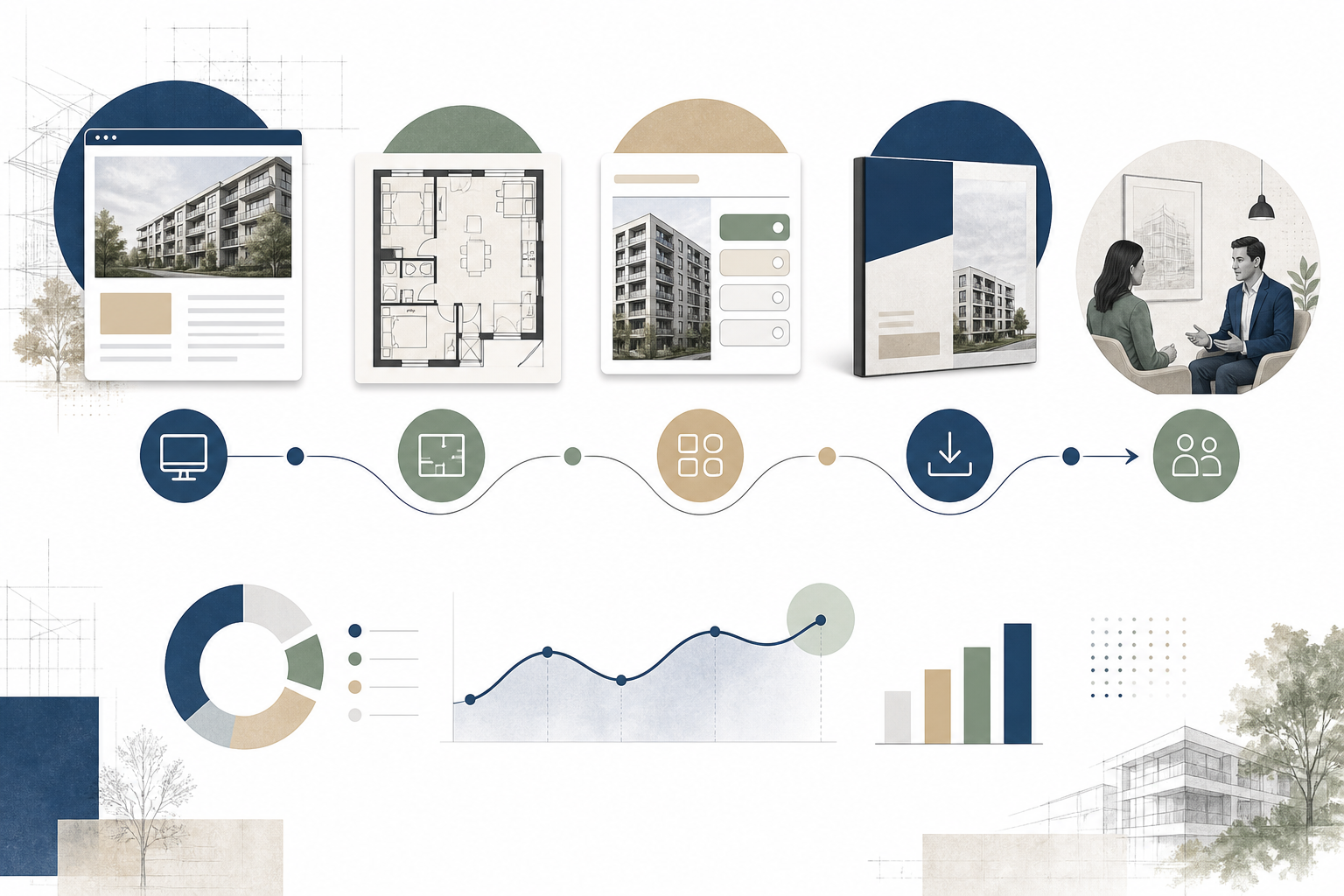
A hierarchy of real estate website engagement signals
A useful measurement system groups interactions by the buyer’s progression rather than treating every event as equal.
1. Discovery signals
Discovery signals show how people arrive and which part of the project earns initial attention. Examples include:
- Landing page and campaign source.
- Project, location, or property type viewed first.
- Scroll or gallery interaction on a project introduction page.
- Video start or completion when the video explains the development.
- Map or neighbourhood context opened.
These signals are useful for understanding acquisition and first impressions, but they are usually too early to represent strong purchase intent. A high-performing campaign can create many visits without producing qualified demand if the landing experience does not support deeper evaluation.
2. Exploration signals
Exploration signals show that a visitor is trying to understand the project in more detail. They may open amenities, move through a masterplan, inspect building phases, view a virtual tour, or use a project-level filter.
For a developer, the pattern is often more informative than one action. A visitor who opens the masterplan, then views a tower, then moves to a unit selector is giving the website a stronger indication of intent than someone who only watches an autoplay video.
3. Evaluation signals
Evaluation signals are closer to the decision. They include:
- Opening a floorplan or floorplate.
- Filtering by bedroom count, size, price, floor, orientation, or view.
- Checking current availability.
- Comparing two residences.
- Reviewing a payment plan or specification.
- Opening construction, developer, or delivery information.
- Returning to a specific unit or view.
These actions are particularly valuable for high-consideration developments because they show what the buyer needs to know before contacting sales. They can also reveal product demand. If many visitors filter for a feature that the website does not explain well, the content and the product team may both benefit from the insight.
4. Progression signals
Progression signals show that a visitor is moving toward a human or commercial next step. Examples include:
- Brochure or floorplan download.
- Pricing request.
- Form start and form completion.
- Click-to-call, email, or WhatsApp action.
- Appointment or virtual presentation request.
- Registration for a future phase or priority list.
- Sharing a unit or shortlist with another decision-maker.
A form start is not the same as a qualified lead, and a brochure download is not a reservation. The value comes from placing each action in the wider path and comparing it with lead quality, appointment rate, and sales outcomes.
5. Return and sales-validated signals
Repeat behaviour can help distinguish casual interest from a project that remains under consideration. Returning to the same project, unit, or floorplan after receiving follow-up may indicate that the buyer is still evaluating the opportunity.
The strongest validation happens when website activity can be connected to sales data. If visitors who check availability and revisit the same unit are more likely to book a presentation, that pattern can inform lead prioritisation. If a high volume of people open a brochure but few accept a call, the team may need to review the follow-up or the information offered.
These are correlations, not universal rules. Every project has different audiences, price points, sales cycles, and market conditions.
Build an event model around buyer questions
Good real estate website engagement measurement starts with a small, consistent event taxonomy. The names should describe meaningful actions, not technical details that only a developer can interpret.
A practical baseline might include:
- `project_view` for a project introduction.
- `masterplan_open` for location or site exploration.
- `unit_filter` for a meaningful filter change.
- `unit_view` for opening a specific residence.
- `floorplan_open` for viewing a plan.
- `availability_check` for inspecting current status.
- `brochure_download` or `specification_download` for a relevant file.
- `form_start` and `lead_form_submit` for the lead journey.
- `appointment_request` for a meeting or presentation request.
- `call_click`, `email_click`, or `whatsapp_click` for direct contact actions.
This does not mean every website needs every event. Start with the actions that map to the project’s actual buyer journey. Google’s documentation on Analytics events distinguishes recommended events from custom events and explains why a consistent event model supports more useful reporting.
Parameters should add context without collecting unnecessary personal information. Depending on the project, useful fields may include project ID, unit type, floor, view category, price band, device type, page type, language, campaign source, and funnel stage. Do not send names, phone numbers, email addresses, or other personal information as event parameters.
Separate engagement from key business events
A clean reporting system distinguishes between signals that describe behaviour and events that represent important business outcomes. Opening a floorplan is valuable context, but it should not be counted like a submitted lead or booked appointment.
Google Analytics refers to important actions as key events. Its guidance on key events explains that any collected event can be marked as a key event when it measures an action particularly important to the business. For a real estate developer, lead submissions, appointment requests, and qualified pricing enquiries may belong in this category. Unit views, filters, and document opens may remain supporting events that explain the path.
This distinction prevents a common reporting problem: declaring every interaction a conversion and then losing sight of which actions are actually connected to pipeline progression.
Connect website behaviour to sales data
Analytics becomes commercially useful when it preserves enough context for sales to act on. A lead should ideally carry the project, campaign source, geography, preferred contact method, and meaningful interaction context into the CRM, subject to consent and the organisation’s privacy obligations.
For example, “New enquiry” is less useful than “New enquiry for Project A, viewed two two-bedroom residences, opened floorplans, requested current pricing, source was paid search.” Sales can respond more naturally when they know what the buyer was trying to understand.
The connection does not need to be invasive. Anonymous engagement can be analysed in aggregate, while identified lead data can be linked only when the visitor has chosen to submit information and the system is configured to respect the relevant consent requirements.
A useful operating loop includes:
- Capture the event with a stable project or content identifier.
- Attach the source and campaign context.
- Preserve the buyer’s stated preferences from the form.
- Route the enquiry to the correct project and sales owner.
- Compare interaction patterns with appointments, reservations, and lead quality.
- Feed the findings back into content, UX, and follow-up design.
MARKETIKA’s guide to high-converting real estate project websites treats analytics, CRM connection, content structure, and CTA hierarchy as one system. The MARKÉTIKA technology stack also shows why advanced analytics and conversion optimisation are most useful when they sit inside a wider UX and web delivery process.
Privacy and consent are part of measurement quality
More data does not automatically create better insight. Real estate teams should decide what they need to measure, why they need it, who can access it, and how long it should be retained.
The Federal Trade Commission’s data security guidance recommends taking stock of the information held, scaling down collection, protecting what is retained, and disposing of data securely when it is no longer needed. The Office of the Privacy Commissioner of Canada’s guidance on meaningful consent emphasises clear explanations, appropriate consent, and user control. The exact obligations depend on the markets in which a developer operates, so analytics and CRM design should be reviewed with qualified privacy and legal professionals.
In practical terms:
- Keep personal information out of analytics event names and parameters.
- Make the purpose of analytics and marketing collection understandable.
- Use role-based access for CRM and sales reporting.
- Define retention and deletion routines.
- Record consent decisions where required.
- Reconcile analytics leads with CRM intake instead of treating analytics as the only source of truth.
Respectful measurement improves trust as well as compliance. Buyers should not feel that exploring a floorplan has silently turned into an opaque personal profile.
Use signals to improve the website
The value of real estate website engagement signals is not the dashboard itself. It is what the team changes after reviewing the data.
Many unit views, few enquiries: The project may attract interest, but the unit information, pricing context, trust layer, or CTA may be too weak. Test clearer comparisons, better next-step language, or more useful sales support.
Many form starts, few completions: The form may ask for too much information, work poorly on mobile, or fail to explain what happens next. Shorten it where possible and make the exchange more transparent.
Many brochure downloads, low sales response: The brochure may be satisfying the immediate information need, but the follow-up could be generic or slow. Create a relevant sequence connected to what the buyer requested.
High interaction with a 3D tool, low progression: The experience may be engaging but disconnected from the decision. Add unit-level context, availability, comparison, and clear contact actions.
Strong repeat visits to one unit: Create a buyer-specific shortlist or make it easier to return to the saved residence. Repeated evaluation is often a reason to improve continuity, not simply to send more advertising.

MARKETIKA’s 3D visualization strategy for developers makes the same broader point: renders, virtual tours, unit selectors, analytics, and CRM workflows create more value when they operate as a connected sales system.
Build a reporting rhythm that sales can use
A weekly or biweekly review can focus on a small set of questions:
- Which sources produced evaluation behaviour, not only visits?
- Which project sections and unit types were explored most?
- Where did visitors drop between unit evaluation and contact?
- Which actions were associated with appointments or qualified leads?
- Did mobile users experience different friction from desktop users?
- Are availability, plans, and pricing content being requested because it is easy to find or because the website is unclear?
- Which changes should be tested next?
Segment by project, audience, geography, device, and source only when the result will change a decision. Too many dashboards can hide the pattern the sales team actually needs.
Geography affects the signal mix
Buyer behaviour and contact expectations vary by market. In the UAE, a WhatsApp click or rapid callback request may be an important progression signal for an off-plan launch. In the USA, form submissions, scheduled consultations, email, and call actions may need stronger weighting for a new development. In Canada, pre-construction buyers may spend longer comparing plans and reviewing documents, while presale audiences in British Columbia may use that term naturally.
The measurement system should not assume that one conversion path fits every audience. It should preserve enough context to show which signals matter for each market and each project.
Frequently asked questions
Is time on page still useful?
Yes, when interpreted alongside page purpose and other events. It can help identify pages that deserve investigation, but it should not be treated as a standalone measure of buyer intent or lead quality.
Should developers track every click?
No. Track actions that answer a commercial or experience question. A smaller event model with consistent names is easier to maintain and more useful than a large collection of disconnected clicks.
Is a brochure download a conversion?
It can be a valuable micro-conversion, but it is not automatically a qualified lead. Measure what happens afterward, including return visits, contact actions, appointments, and sales feedback.
What if the website is not connected to a CRM yet?
Start with a clear event model, consistent source tracking, and a simple lead log. Plan the future CRM fields while implementing the website so the connection can be added without rebuilding the measurement foundation.
Can engagement signals improve the website itself?
Yes. They can reveal which information buyers value, where they get stuck, which units attract comparison, and which contact paths create friction. The purpose of measurement is to improve the buyer journey and the sales process, not to produce more charts.
Final takeaway
Real estate website engagement signals are most useful when they describe progress toward a decision. Floorplan opens, unit filters, availability checks, repeat visits, document requests, and contact actions often reveal more than session length alone.
The strongest system connects those signals to project content, CRM context, privacy-aware governance, and sales outcomes. When developers measure what buyers are trying to understand, they can improve the website, prioritise follow-up, and build a more credible path from digital attention to a real conversation.


