


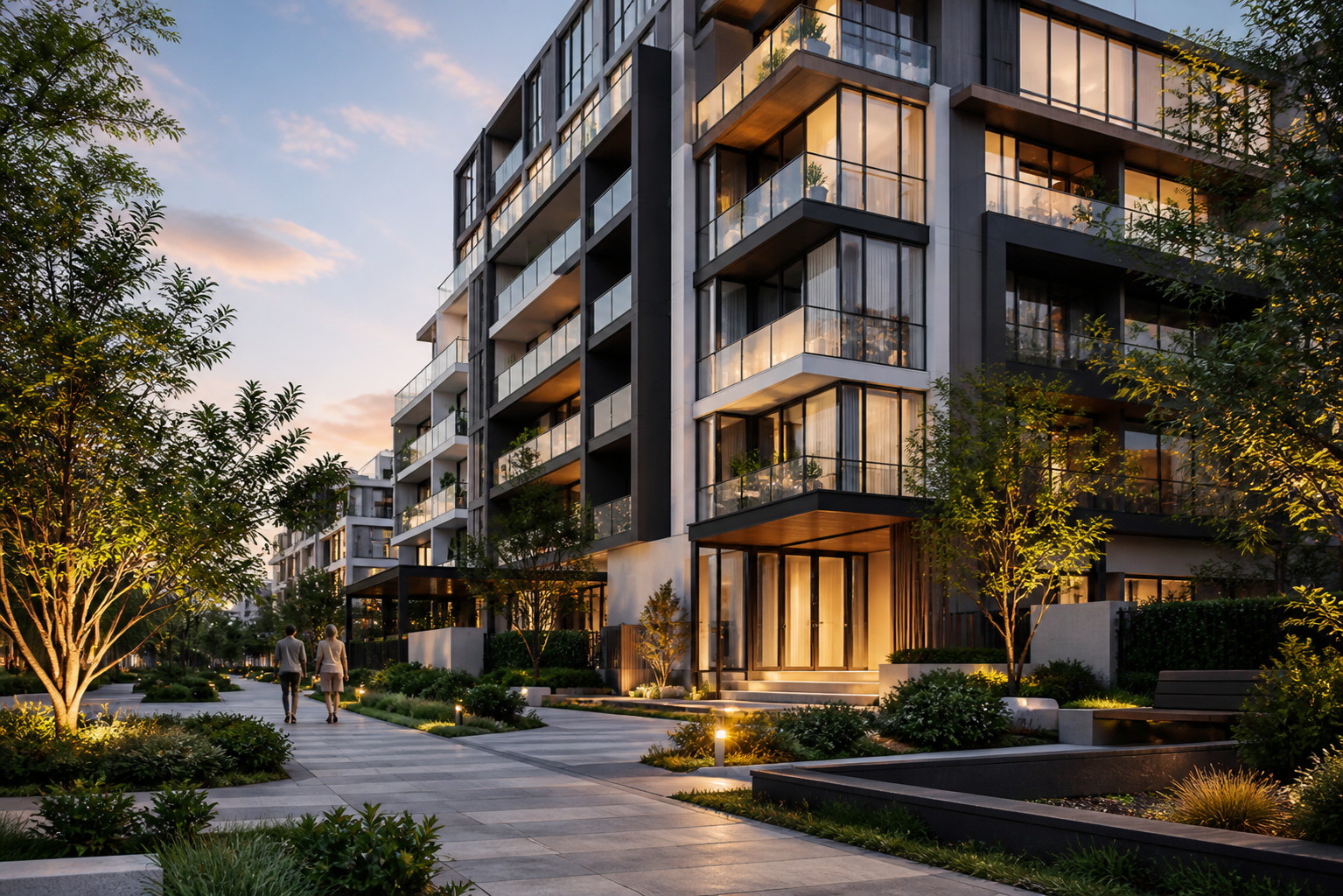
A sales appointment is a meaningful commitment. A buyer is offering time, attention, and often personal financial information, so the project website has to earn the next conversation before it asks for it.
The short answer is that buyers need enough evidence to decide that a development is relevant, credible, and worth discussing. They should be able to understand the project, its location, its unit mix, its visual character, its price level, and the next step without starting with a blank sales call. The appointment then becomes a progression from informed interest, not a substitute for basic information.
That distinction matters for developers in the UAE, the USA, Canada, and other international markets. A clear digital experience does not remove the sales team from the process. It gives the team better conversations with people who already understand why they are there.
The website should do part of the qualification work
According to the National Association of REALTORS® 2024 Profile of Home Buyers and Sellers, 43% of U.S. buyers said their first step was looking for properties online. The same report found that 69% used a mobile or tablet device during the search, while photos, detailed property information, and floor plans were among the digital features buyers considered useful.
This does not mean every buyer wants a fully self-service purchase. In the same report, 88% of buyers purchased through an agent or broker. The lesson is more practical: buyers often research independently, then use a sales professional to interpret options, negotiate, and move the decision forward.
A project website should therefore answer the questions that make a sales conversation useful rather than forcing the sales team to repeat the brochure.
1. What is this project, and why might it matter to me?
The first screen should establish a clear reason to care. Buyers should understand whether the project is a family-oriented community, a city residence, a branded residence, a resort-led development, or an investment-focused opportunity. They should also understand what makes it distinct without having to decode vague language such as “a new standard of living.”
A strong opening combines a specific project promise with evidence. That could mean a waterfront setting, a walkable mixed-use district, a limited collection of large residences, a hospitality partnership, or a particular architectural idea. The claim should be grounded in what the project actually delivers.
The goal is not to explain everything above the fold. It is to give the right buyer a clear reason to continue.
2. Where is it, and what does the location feel like?
A pin on a map is not enough. Buyers need context that connects the address to daily life and long-term value.
Useful location content can include:
- A clear map showing the project in relation to major roads, transit, airports, business districts, schools, retail, parks, and cultural destinations.
- Realistic travel times with a note about whether they are typical, estimated, or traffic-dependent.
- Views of the surrounding streetscape, coastline, skyline, landscape, or public realm.
- A concise explanation of how the project sits within the wider district.
- Information about access, parking, deliveries, and practical arrival experience.
For an international buyer, this context reduces the distance between a remote browsing session and an actual mental picture of the place. For a local buyer, it helps them evaluate the project against the routines they already understand.
3. Which unit type fits my needs?
A buyer should not have to open a PDF and search through dozens of pages to discover whether the project includes the home they want. The unit mix should be visible, filterable, and described in practical language.
Show the available formats, approximate sizes, bedroom counts, outdoor space, storage, orientation, parking, accessibility features, and key differences between layouts. If the project includes studios, one-bedroom residences, family apartments, townhomes, or penthouses, each format should have a clear place in the information hierarchy.
Floor plans should be legible on mobile, with room names and dimensions that can be understood without specialist knowledge. Where possible, connect a floor plan to a view, a building position, and an availability state. Buyers are more likely to book when they can see how the abstract unit relates to the building and the life they imagine inside it.
4. What will the project look and feel like?
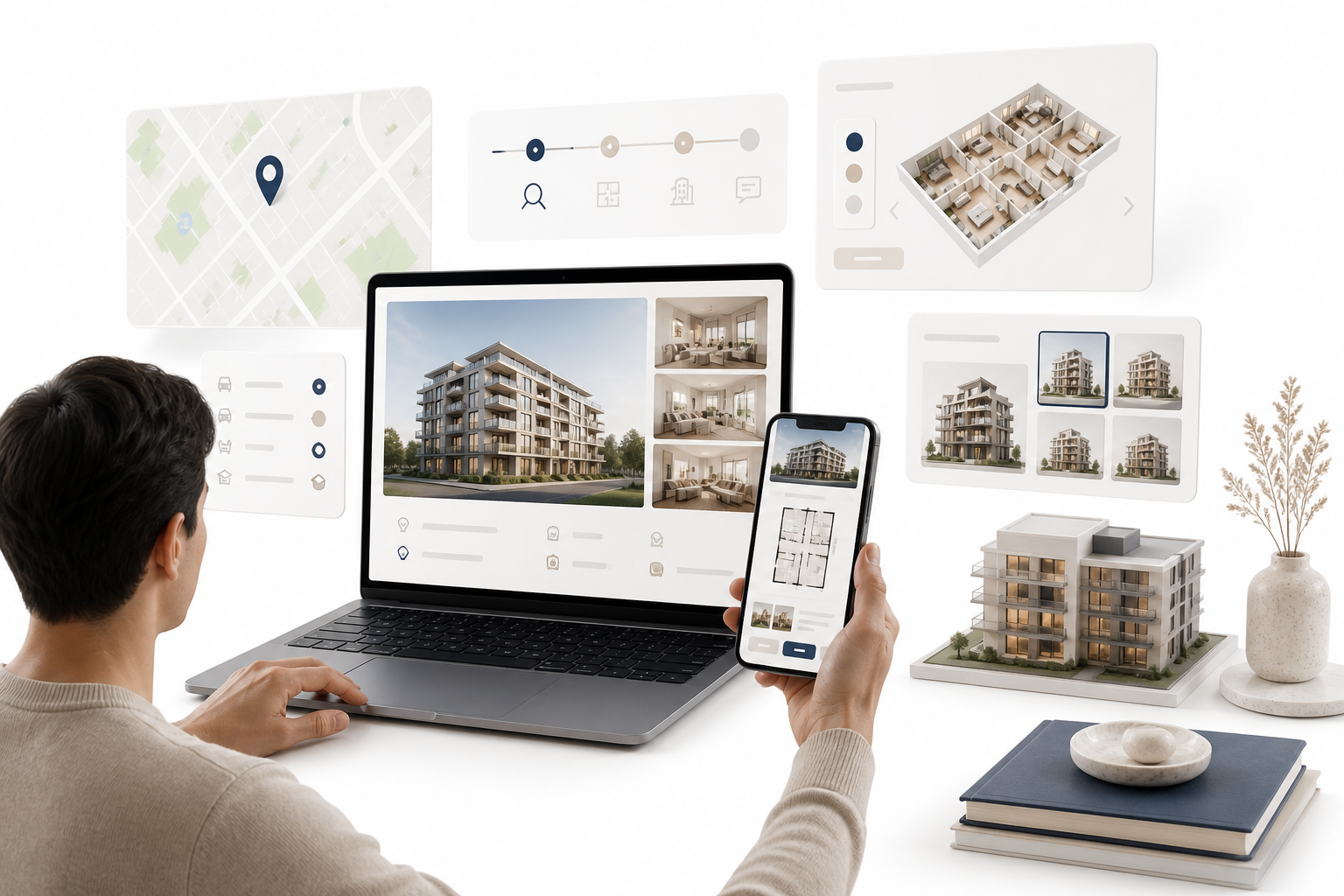
A pre-construction project has an evidence problem. Buyers are being asked to evaluate a future environment through plans, promises, and visualizations. High-quality CGI cannot replace factual information, but it can help buyers understand scale, atmosphere, materials, views, and the relationship between buildings and public space.
The best visual system has several layers:
- A hero image that establishes the architectural character.
- Exterior views that explain arrival, massing, landscaping, and context.
- Interior imagery that communicates materials, light, proportions, and finish quality.
- Floor plans and diagrams that explain what imagery alone cannot.
- Interactive or selectable elements that help buyers compare units and orientations.
MARKETIKA’s real estate development projects show how project websites, interactive 3D, and sales tools can work together. The principle is simple: visual polish should make the decision easier, not hide the information needed to make it responsibly.
5. What price level and payment structure should I expect?
A buyer does not always need a final quote on the first page, especially when inventory and pricing change. They do need enough context to know whether the project belongs in their consideration set.
That context might include a starting price, price band, typical unit range, payment milestones, financing guidance, service charges, or a clear explanation of what is and is not included. If exact figures are not public, say what will be provided after registration and give buyers a meaningful way to describe their budget.
Avoid using “request price” as a way to conceal every commercial detail. It can create more leads, but it can also attract people who are never likely to qualify. A useful form can ask whether the buyer is exploring, comparing, or ready to discuss a specific unit, while still respecting privacy and local requirements.
6. Why should I trust the developer and the delivery team?
Trust is not created by a large “about us” paragraph. It comes from verifiable proof arranged at the moment uncertainty appears.
Depending on the project and market, useful credibility signals include:
- Completed projects with clear locations and dates.
- Delivery history and relevant experience.
- Named architects, interior designers, operators, and consultants.
- Construction updates or documented progress for an active site.
- Ownership, warranty, handover, or management information where relevant.
- Testimonials or third-party recognition that can be verified.
A premium brand should not make these details feel defensive. They can be presented as a quiet evidence layer that gives the buyer confidence to move from browsing to conversation. MARKETIKA’s Real Estate Developer Branding Blueprint is a useful reference for thinking about how positioning, proof, and experience should reinforce one another.
7. What exactly happens after I submit my details?
The call to action should describe a real next step. “Book a Sales Call” is appropriate for a buyer who is already ready to speak. It is not the only option.
Consider a progression such as:
- Explore floor plans.
- Check current availability.
- Request pricing and payment details.
- Arrange a virtual presentation.
- Speak with a project specialist.
- Book a private appointment.
The button label should match the information the buyer has just viewed. Someone comparing layouts may want to check availability. Someone studying payment milestones may be ready for a specialist conversation. A buyer who has already selected a unit may want a scheduled appointment.
Make the handoff useful for sales
The website should capture enough context to make the next interaction personal. The exact fields depend on the project, but a useful handoff may include the source campaign, project or unit viewed, buyer location, intended use, preferred unit type, budget range, timeline, language, and preferred contact method.
This information should flow into the CRM or sales workspace with a clear record of consent and the buyer’s requested next step. The sales team should not begin with “How can I help?” when the buyer has already said they want a two-bedroom residence with a specific view.
A good handoff also protects the brand. Buyers experience the website and the sales team as one project. If the digital experience is precise but the follow-up is generic, confidence falls quickly.

A practical pre-appointment checklist
Before inviting a buyer into a sales conversation, check whether the project experience answers these questions:
- What is the project and who is it for?
- Where is it, and what is nearby?
- Which unit formats are available?
- Can I understand the layouts, views, finishes, and amenities?
- What price level or payment structure should I expect?
- Who is delivering the project, and what evidence supports that?
- What will happen after I submit my details?
- Will the sales team understand what I was looking at?
If several answers are missing, adding more advertising may increase traffic without improving sales efficiency. A clearer experience is often the better first investment.
Frequently asked questions
Should developers publish exact pricing?
Not always. Pricing can change by unit, release, market, and inventory. However, the buyer should receive useful pricing context, whether that is a range, a starting point, a payment plan, or a transparent explanation of when detailed pricing will be shared.
Does giving buyers more information reduce lead generation?
It can reduce low-intent form submissions, but that is not necessarily a negative outcome. The goal is qualified demand and productive conversations, not the largest possible contact count. Clear information may also build trust with buyers who are comparing several projects.
What content matters most for a pre-construction project?
Start with location, unit formats, floor plans, visual quality, delivery credibility, pricing context, and a clear next step. Then add deeper content such as construction updates, design rationale, consultant profiles, and neighborhood guidance as the buyer moves closer to a decision.
Should every buyer see the same CTA?
No. A considered journey can offer different actions based on the buyer’s stage. Someone discovering the project may want to explore. Someone comparing units may want availability. Someone with a preferred unit may be ready to book an appointment.
Final takeaway
The strongest real estate sales appointment is not created by withholding information. It is created when the website gives the buyer enough clarity to recognize a fit and enough confidence to want expert help with the next decision.
For developers, that means treating the project website as part of the sales system. Positioning, location context, floor plans, visual evidence, pricing guidance, credibility, and CRM handoff should work as one experience. When they do, the appointment feels like the natural next step in the buyer journey.


