


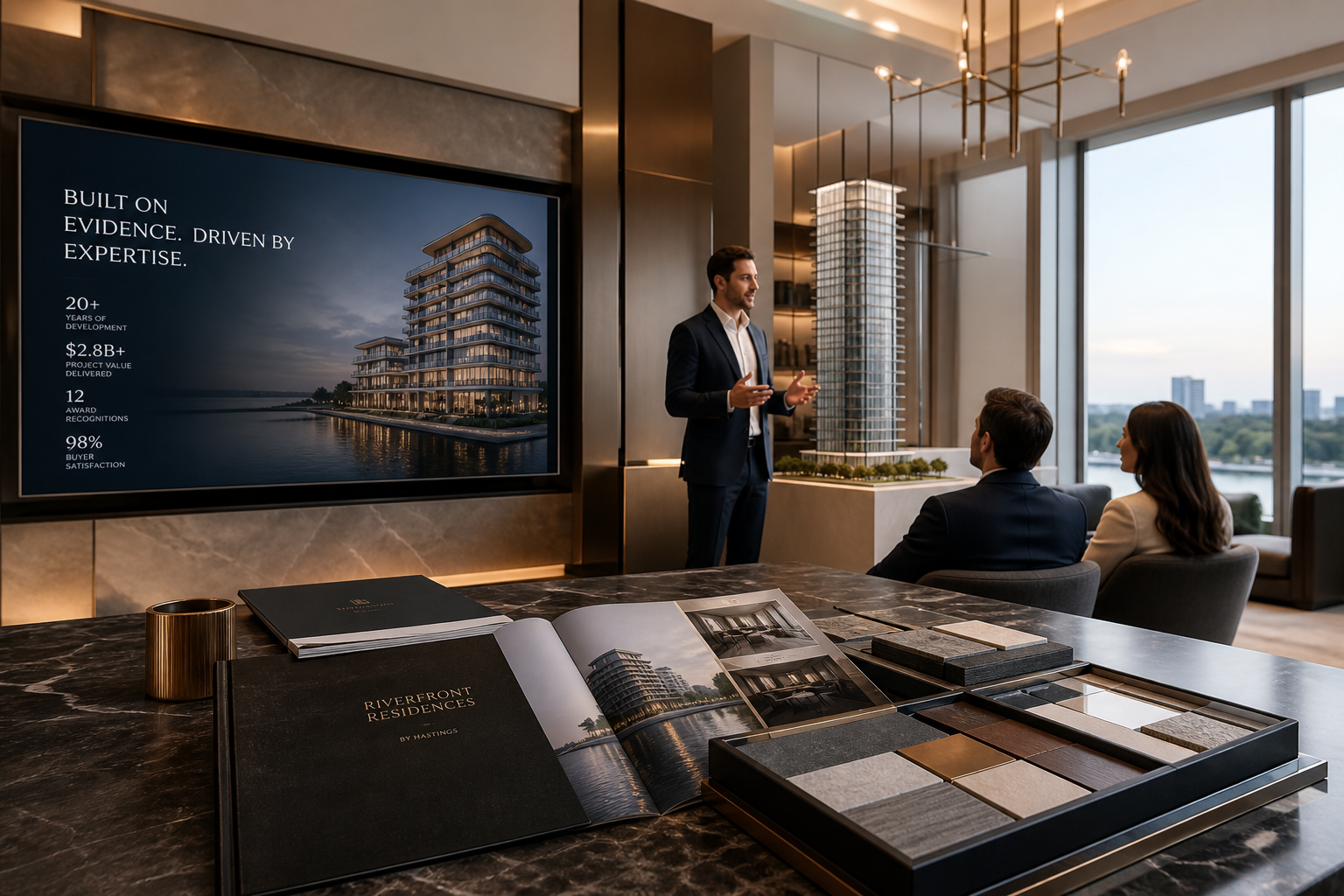
Premium. Exceptional. Iconic. World-class.
Luxury real estate marketing is full of language like this.
The problem is not that the words are false. The problem is that they are rarely enough.
When every high-end launch uses the same vocabulary, adjectives stop doing strategic work. Buyers may still notice them, but they no longer explain why one project deserves more trust, more urgency, or more pricing power than another.
That is where proof matters.
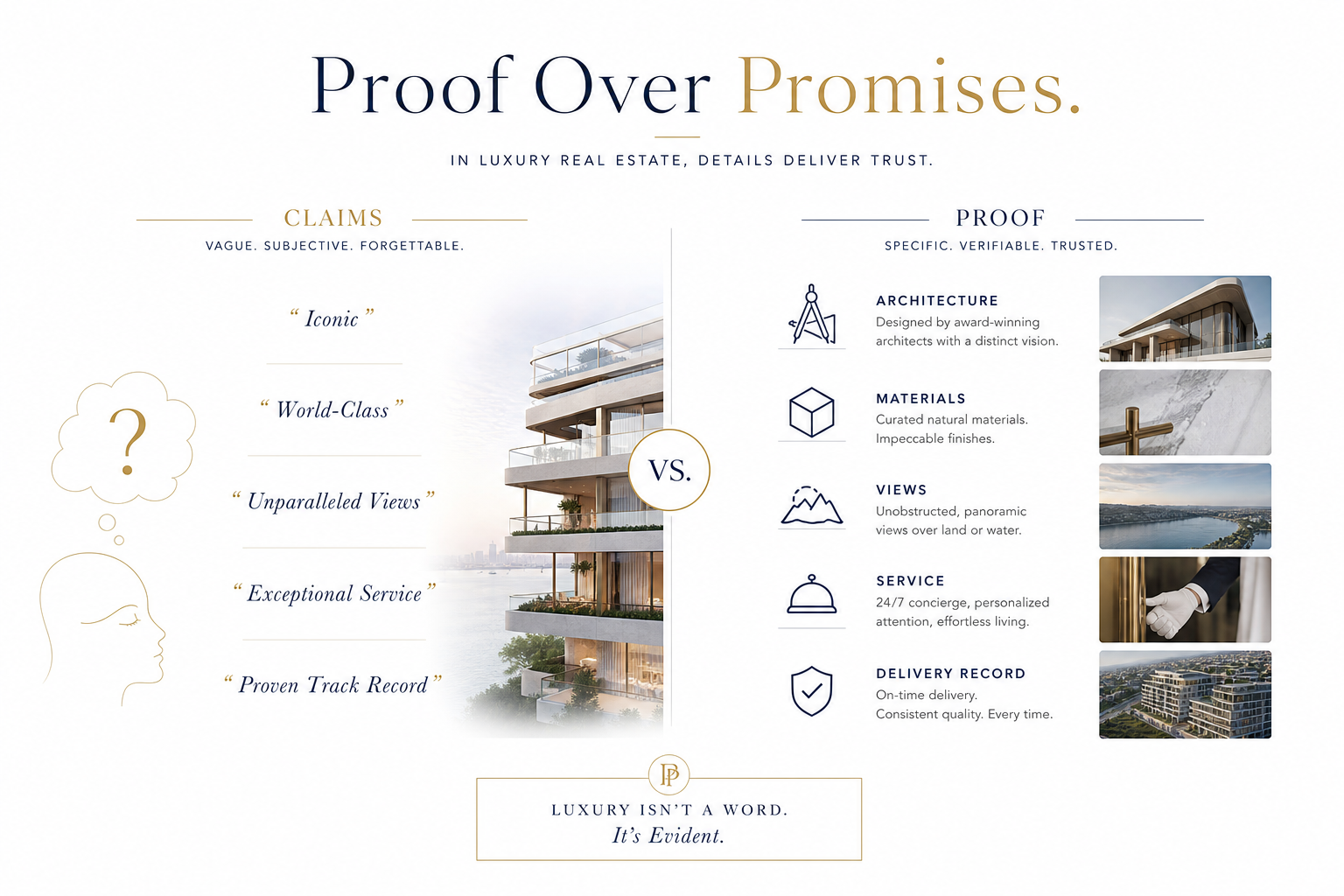
In luxury real estate, proof is more persuasive than generic claims because buyers can evaluate it. Architecture, materials, views, brand partnerships, low-density planning, service logic, developer history, and finished project examples all make premium positioning easier to believe. Strong marketing does not force the buyer to accept the label. It gives them enough evidence to reach the conclusion themselves.
Why generic luxury language loses power
Luxury is a crowded category.
In most markets, especially in UAE, USA, and Canada urban high-end segments, competing projects can all claim:
- premium finishes
- resort-style amenities
- prime location
- elevated lifestyle
- world-class design
Even when those statements are directionally true, they are difficult to own. If every competitor sounds expensive and polished, the audience still needs a reason to care about one specific project.
This is exactly why luxury is a category, not a positioning strategy is such an important principle. The category tells buyers where the project sits. Positioning explains why it should win.
What counts as proof in luxury real estate
Proof is not one thing. It is the collection of specifics that make the premium claim credible.
Useful proof points often include:
Named design and architecture partners
A respected architect, interior designer, or landscape practice can materially strengthen the story, but only if their role is explained clearly.
Do not simply show a logo. Show why their involvement matters to the buyer. What did they contribute to the building's character, privacy, livability, or status?
Material and product specificity
Italian stone, custom joinery, hospitality-grade service planning, branded kitchens, private lift access, acoustical control, or curated wellness spaces tell a stronger story than a vague phrase such as refined finishes.
Specifics are easier to understand and easier to remember.
Site conditions and spatial advantages
Some premium value comes from what cannot easily be replicated:
- protected water views
- a rare location within a known district
- exceptionally low density
- privacy logic
- orientation advantages
- direct marina, golf, or beachfront adjacency
These are stronger than abstract statements because they create a real reason to believe the pricing logic.
Developer track record
In categories where buyers are committing to a future asset, the developer's history becomes part of the proof. Completed projects, delivery quality, and a coherent parent-brand presence matter.
This is why MARKETIKA's thinking on developer reputation and trust-building is not separate from conversion strategy.
Service and operating model
Luxury is not only architectural. It is operational.
Concierge structure, valet logic, wellness programming, member-style amenities, branded-residence service, private arrival experience, and resident management standards can all support premium positioning if they are described clearly.
Why proof helps sales, not just marketing
A proof-based strategy is not only better for websites and campaign copy.
It gives brokers and sales teams stronger raw material.
Instead of repeating broad luxury language, they can explain:
- why the building feels more private
- why the site is unusually valuable
- why the design team matters
- why the materials justify the positioning
- why the service model is different from a nearby competitor
That changes the tone of the conversation.
The buyer no longer hears hype. They hear reasons.
And reasons travel better across media, websites, one-to-one sales conversations, and AI-retrieved content than vague adjectives do.
The strongest premium marketing translates proof into meaning
Proof alone is not enough if it sits as a raw list.
The real job is to connect the evidence to buyer significance.
This is where many luxury campaigns fall short. They have the assets, but they do not translate them into a persuasive strategic story.
How developers can build a proof library
A useful premium proof library should be assembled before launch and shared across teams.
It can include:
- architecture and design rationale
- materials and specification highlights
- location advantages that are difficult to copy
- developer track record and completed examples
- service model or operational differentiators
- visual assets that demonstrate the above clearly
- approved wording that explains why each point matters
This library should inform the website, brochures, campaign copy, broker toolkit, sales presentations, and follow-up messages.
That is also why MARKETIKA's project portfolio for developers and expertise across design, web, and sales tools are useful references. Premium positioning gets stronger when the evidence is carried consistently across every touchpoint.
Common mistakes in luxury messaging
The same problems appear again and again:
- leaning too heavily on adjectives
- treating logos as proof without explanation
- listing amenities without connecting them to buyer meaning
- hiding developer proof too deeply
- using the same luxury language every competitor uses
- failing to equip sales teams with specific talking points
These are not only brand problems. They are conversion problems.
Final takeaway
Strong luxury marketing does not simply tell buyers the project is premium.
It gives them enough evidence to believe it.
When proof leads the strategy, the project becomes easier to differentiate, easier to explain, and easier to trust. That is what gives premium positioning real weight in the market.


