



Not every enquiry deserves the same response.
A buyer asking for pricing on a specific unit is not behaving like someone casually downloading a brochure. A GCC investor comparing payment plans is not identical to a local end-user asking about a school catchment. A person who spent ten minutes on floorplans is not the same as someone who bounced after a homepage visit.
That is why lead qualification matters.
For real estate developers, qualification should identify the signals that help sales prioritize and personalize follow-up without making the buyer work unnecessarily hard. The objective is not to build a longer form for its own sake. It is to create a cleaner handoff between marketing and sales so the first real conversation starts with context rather than guesswork.
Qualification should match buyer intent
One of the biggest mistakes in developer marketing is treating every enquiry as if it were the same kind of demand.
In practice, different actions signal different levels of seriousness:
- a brochure request often signals early interest
- a pricing request usually signals stronger evaluation intent
- a unit-specific enquiry suggests product fit is already narrowing
- a meeting or callback request shows readiness for a more direct sales step
The stronger the signal, the more useful qualification becomes.
This is why real estate digital sales funnels should be designed as connected systems. Qualification is not a separate administrative layer. It is part of how digital interest becomes a relevant human conversation.
What information is actually useful
Developers do not need to collect everything.
They need to collect what helps sales act intelligently.
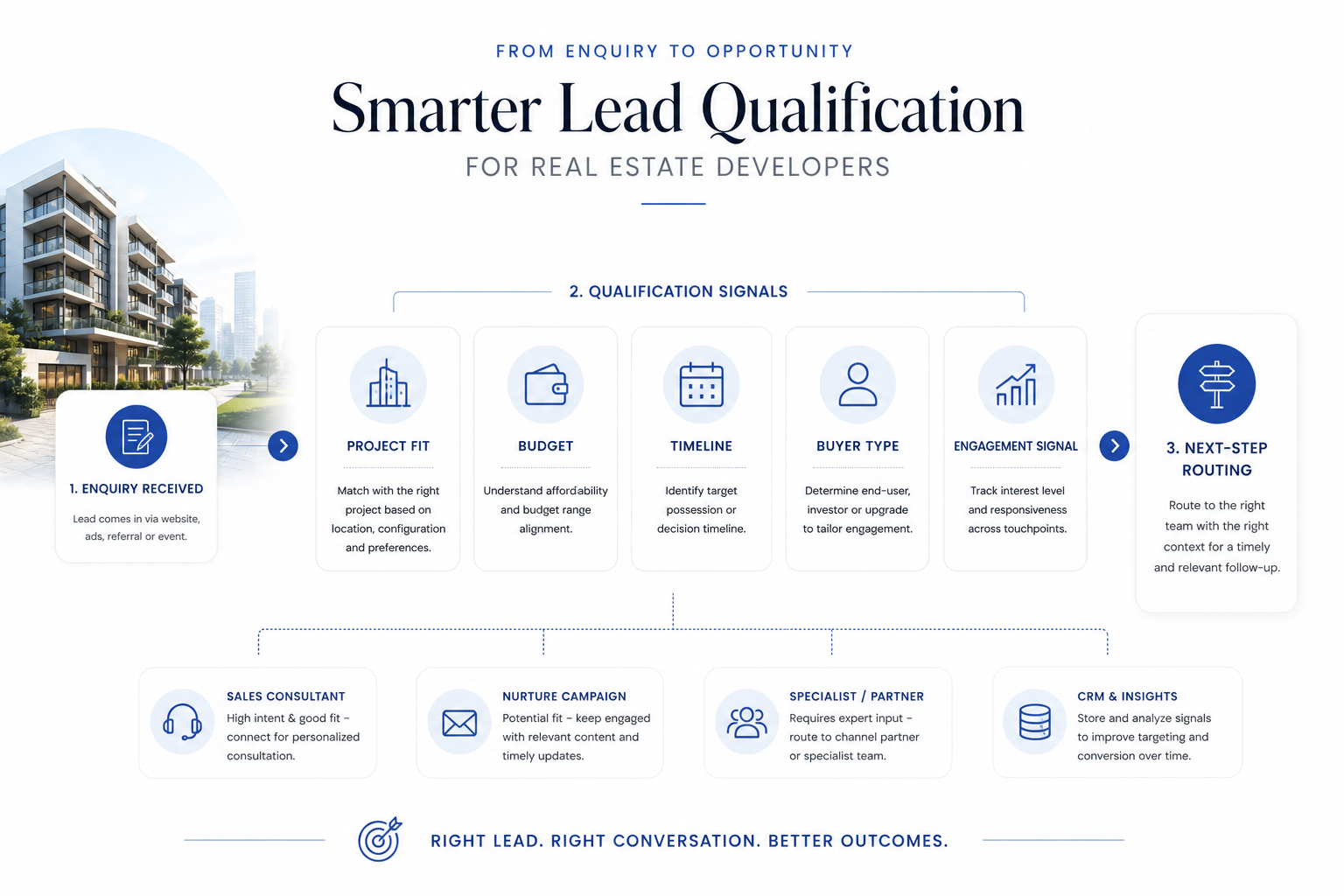
Useful qualification signals often include:
- project or page of interest
- unit type or property type
- investor versus end-user intent
- budget band, where commercially relevant
- timeline or urgency
- preferred contact method
- geographic market or language needs
- requested next step
These fields matter because they change the follow-up.
A team handling a premium waterfront launch in Dubai may route investor-style enquiries differently from family-oriented end-user demand. A mixed-use project in North America may prioritize leasing-related questions differently from ownership-related ones. The point is not the exact field set. The point is the logic behind it.
The form should not do all the work
Qualification is not only a form-design question.
It also lives in:
- campaign source
- landing page context
- floorplans or tools the buyer viewed
- CTA chosen
- CRM routing rules
- follow-up priority standards
This is one reason CRM integration for real estate websites matters commercially. If the website captures useful context but the CRM discards it, the handoff still fails.
A strong setup preserves source and behavior so the sales team already knows something before reaching out.
Avoid over-qualifying too early
Long forms can reduce conversion when the buyer is still exploring.
That does not mean developers should avoid qualification. It means they should apply it progressively.
A practical rule is simple:
This makes the journey feel more natural.
The buyer is not being interrogated upfront. They are sharing more information as their seriousness increases.
Qualification should help sales, not burden buyers
A good qualification system improves both sides of the process.
For buyers, it reduces repetition and helps them reach the right person faster.
For sales teams, it creates:
- cleaner prioritization
- better first-contact relevance
- stronger routing by project or segment
- clearer reporting on lead quality
This is closely related to MARKETIKA's thinking on lead generation for real estate developers. The point is not to collect names. It is to create better conversations.
Common qualification mistakes
The same issues appear repeatedly:
- asking too much too early
- collecting fields that nobody actually uses
- failing to route leads differently by intent
- treating every CTA as equivalent
- separating qualification from CRM logic
- not reviewing which fields actually improve conversion or sales efficiency
Qualification should make the system smarter. If it only makes the form longer, it is probably poorly designed.
Final takeaway
Lead qualification should make sales follow-up more relevant, not make the buyer work harder than necessary.
The strongest developers treat qualification as part of the buyer journey, not as a paperwork exercise. When the right context is collected at the right moment, marketing hands over something more valuable than a raw contact. It hands over a better starting point for trust and conversion.


