



A buyer may see a social ad on Monday, browse the website on Tuesday, receive a broker PDF on Wednesday, visit the presentation centre on Saturday, and speak with a salesperson the following week.
To the buyer, that is one experience.
To the developer, it often involves multiple teams, agencies, files, deadlines, and moving pieces.
That is where consistency becomes difficult, and valuable.
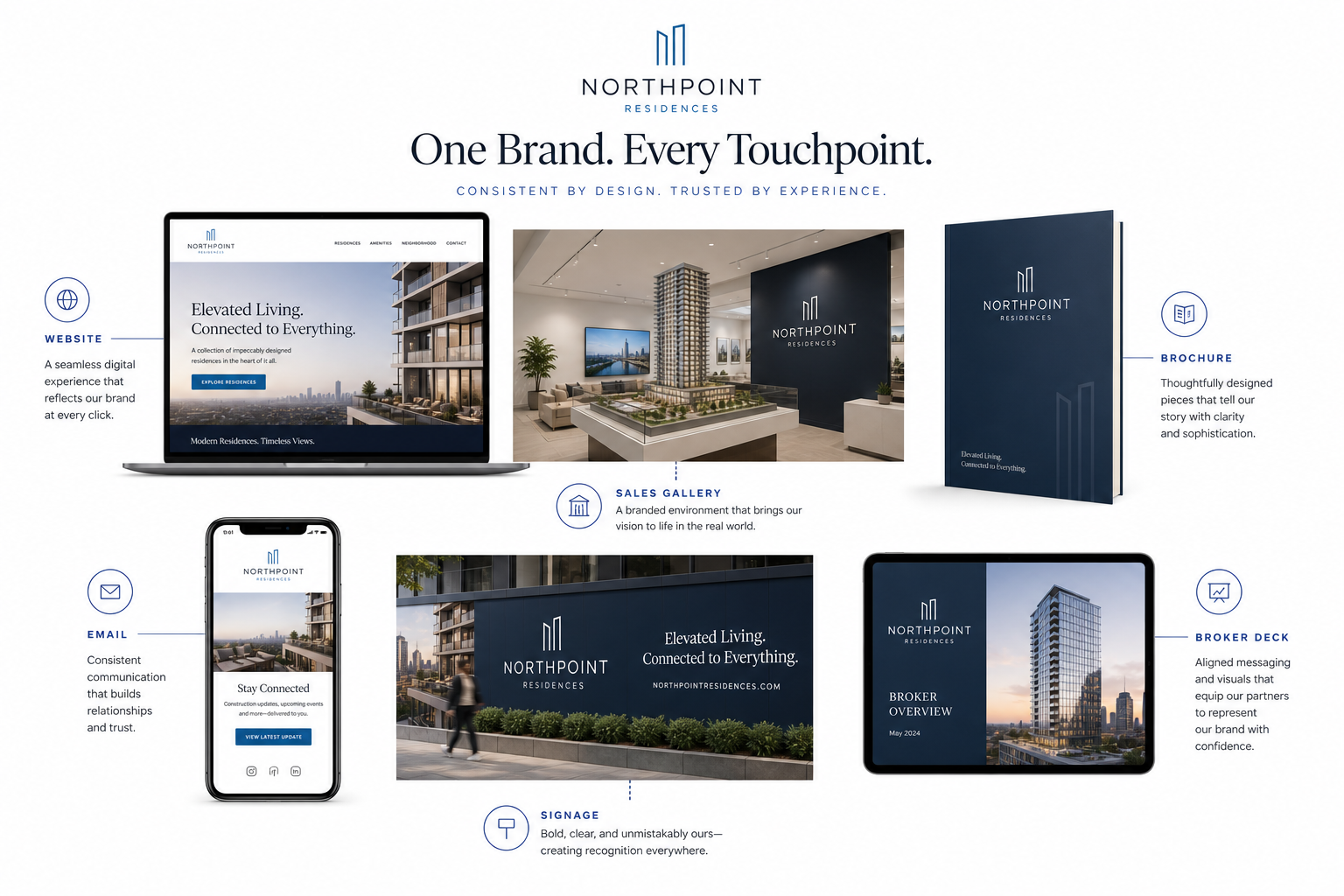
Real estate brand consistency is not only about matching colors or fonts. It means the project's positioning, tone, visuals, information, and service behavior all reinforce the same promise across digital and physical environments. When that consistency is strong, each touchpoint makes the next one easier to trust.
Consistency is more than visual identity
Visual identity matters. It helps a project feel recognizable and intentional.
But the brand is also shaped by:
- the way the project story is told
- the language used by brokers and sales teams
- the quality of the renders and materials
- whether pricing or availability feels current
- whether the website and physical space feel like the same project
- how follow-up behaves after interest is shown
This is why a beautifully branded campaign can still feel weak if the presentation centre is generic, the broker materials are outdated, or the sales team speaks in a completely different tone.
Where inconsistency usually appears
The weak points are usually predictable.
Old broker materials
Brokers may still circulate older PDFs, outdated renders, or descriptions written before the latest positioning was finalized.
Campaign landing pages created outside the core brand system
When quick campaign pages are built in isolation, the tone and story often drift.
Sales decks and follow-up emails
These assets are sometimes produced pragmatically and updated less often than the website, which creates a mismatch right when the buyer becomes more serious.
Physical presentation environments
A polished website followed by a generic or disorganized sales gallery creates a brand break that buyers feel immediately.
A practical brand system makes consistency easier
Consistency rarely comes from asking people to be more careful.
It comes from giving teams a usable system.
A practical project brand system can include:
- approved positioning and key messages
- current image and render library
- standard project descriptions
- source-of-truth pricing and availability references
- templates for broker decks, email, and print materials
- clear ownership for updates
The aim is not bureaucracy. The aim is making the right version the easiest version to use.
Why consistency matters more in pre-construction
In completed real estate, the finished product can repair some communication weaknesses because the buyer can see what exists.
In pre-construction and off-plan sales, the experience around the project carries more weight. Buyers are judging the future through the current presentation.
That means every touchpoint becomes evidence.
This is one reason the project launch experience is part of the product and why branding for developers should be treated as a system rather than a decorative layer.
The best consistency protects both trust and efficiency
Consistency is often discussed as a brand issue. It is also an operational one.
When the website, sales team, broker network, and presentation materials all use the same language and current information:
- buyers become less confused
- sales spends less time correcting mismatched expectations
- brokers distribute stronger messages
- updates move faster through the system
- the project feels more organized overall
In other words, consistency reduces friction as well as ambiguity.
A simple audit developers can run
A practical review can start with a few questions:
- Does the website tell the same story as the brochure?
- Are the broker materials using the current positioning?
- Does the sales team use the same terms the campaign uses?
- Are the latest visuals, floorplans, and descriptions easy to access?
- Does the presentation space reinforce the same promise the digital materials make?
- Are post-enquiry emails and follow-up aligned with the project tone?
If several answers are no, the project may feel less coherent than the team realizes.
Final takeaway
Every touchpoint does not need to look identical.
It needs to feel like it belongs to the same project, the same promise, and the same developer.
When consistency is handled well, the market experiences one coherent brand instead of a collection of disconnected materials. That coherence makes the project easier to remember, easier to understand, and easier to trust.


