



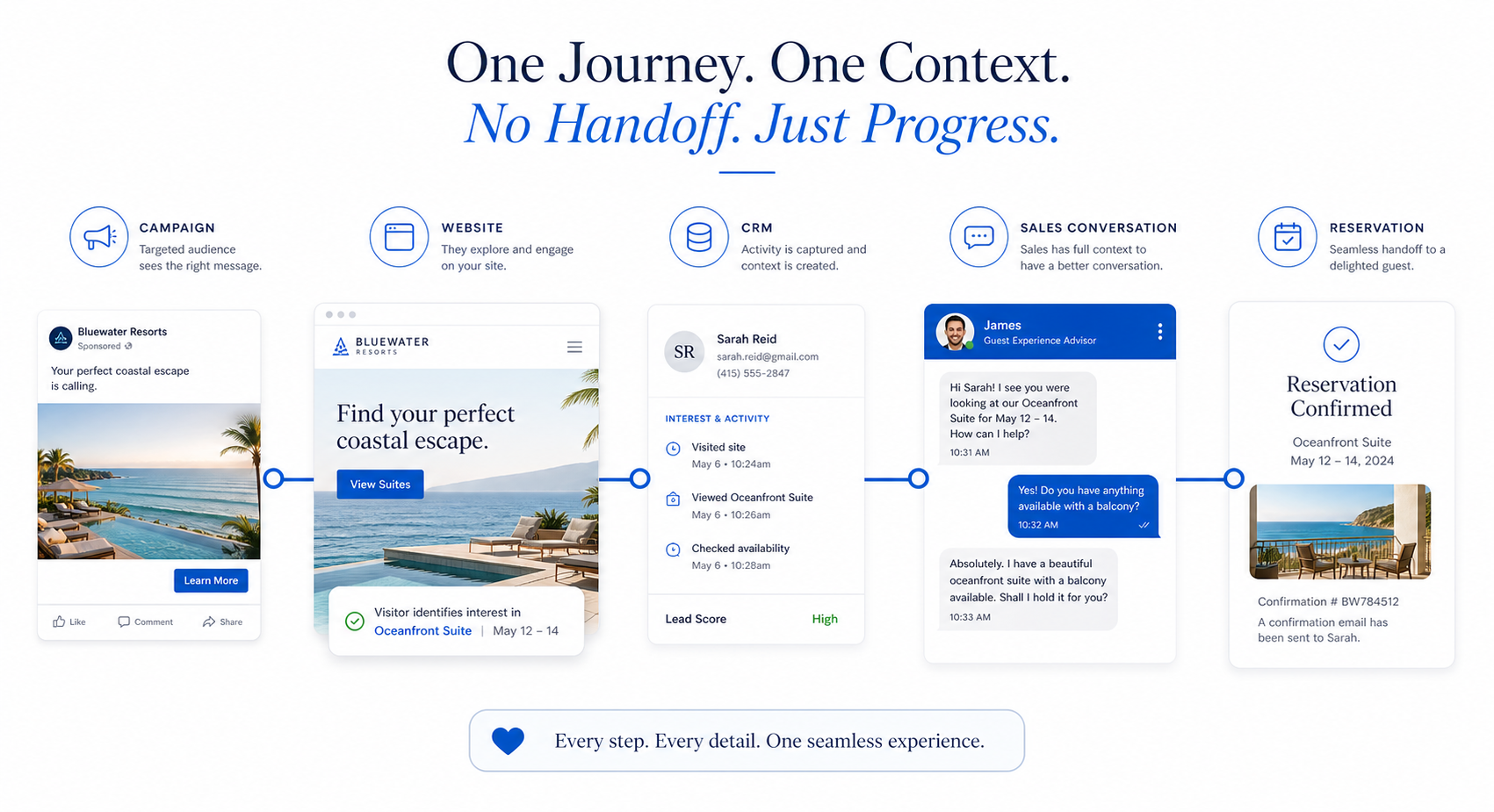
A buyer should never be able to tell where marketing ended and sales began.
Internally, those may be separate teams with different tools, responsibilities, and metrics. Externally, the buyer experiences one company, one project, and one promise.
That is why the marketing-to-sales handoff matters so much.
When it works, the project simply feels clearer and more relevant as the buyer moves forward. When it fails, the experience becomes visibly fragmented. The ad says one thing. The website frames the project one way. The sales conversation uses different language. The buyer repeats information they already submitted. Trust drops for reasons that feel small internally but noticeable externally.
Where the handoff usually breaks
Most breakdowns are not dramatic.
They are operational gaps that the buyer experiences as friction:
- sales receives too little lead context
- marketing cannot see what happens after the form fill
- positioning is not carried into the first conversation
- different teams use different versions of assets or pricing logic
- response timing varies unpredictably
- the next step after enquiry feels unclear
Each of these issues adds work for the buyer at exactly the moment the experience should start feeling easier.
Buyers experience one brand, not two departments
From the buyer's perspective, there is no meaningful distinction between:
- the ad or portal listing
- the project website
- the lead form
- the broker or sales representative
- the presentation centre
- the follow-up sequence
Every part of that path becomes evidence about the project and developer.
If the early marketing feels premium but the follow-up feels generic or disorganized, the premium positioning becomes less believable. This is one reason response speed is part of the real estate brand in broader principle. Service behavior affects trust just as much as copy and visuals do.
What a better handoff preserves
A strong handoff does not require collecting endless data.
It requires preserving the right context.
That often includes:
- campaign source
- project or page of interest
- unit or product interest where available
- buyer type or intent signal
- CTA used
- requested next step
- ownership of follow-up
This is exactly why CRM integration for real estate websites matters so much. A lead should not enter the CRM as a blank record if the buyer already showed meaningful behavior before contact.
The website is part of the handoff system
Many developers treat the website as marketing and the CRM as sales.
That separation is too simplistic.
The website is already collecting, framing, and qualifying intent before the handoff happens. The stronger the site becomes at answering buyer questions, surfacing proof, and clarifying next steps, the better the sales conversation starts.
This aligns closely with best real estate website features for developers and lead generation for real estate developers: the digital layer should not stop doing work the moment someone submits a form.
Marketing needs feedback from sales too
Handoff is not one-directional.
Sales teams hear the objections, confusion points, and recurring buyer questions that marketing often cannot see in analytics alone. If that information never travels back, the same weak spots repeat.
A connected system should allow marketing to learn:
- which channels create serious conversations
- where buyers still feel uncertain
- which parts of the project story are landing
- which parts of the website need clearer explanation
- what causes disqualification most often
That is how the buyer journey gets better over time instead of simply producing more activity.
A practical checklist for developers
A useful internal review sounds like this:
- Does sales know what the buyer engaged with before the enquiry?
- Are marketing and sales using the same positioning language?
- Is response timing defined by intent level?
- Do both teams use the same current project assets?
- Can marketing see downstream quality and conversion?
- Are recurring questions shaping the website and campaign assets?
If several of these answers are weak, the handoff is probably visible to the buyer even if the team has normalized it internally.
Final takeaway
Marketing and sales may be separate teams inside the company.
To the buyer, they are one experience.
Developers who design the handoff properly create less repetition, more continuity, and stronger trust at the exact moment attention is supposed to become commitment. That is why the buyer should never feel where one team stopped and the other started.


