



When the market slows, visibility is often the first thing teams want to cut.
That instinct is understandable. Demand feels less predictable, budgets come under pressure, and every line item is re-examined.
But going quiet can create a second problem on top of the market itself.
In real estate development, long periods of silence rarely feel neutral. Buyers, brokers, lenders, and partners often read silence as uncertainty. Even when the business is stable, disappearing from view can weaken confidence, reduce future demand memory, and make the next push more expensive.
The smarter approach is usually not to keep spending recklessly. It is to stay visible more selectively.
Developers should not go dark in uncertain markets because credibility compounds over time, and absence can quietly erode it. A disciplined presence through content, project updates, database nurturing, and sharper digital fundamentals often creates better conditions for the recovery than disappearing and trying to restart from zero later.
Silence creates questions whether you intend it or not
When a developer stops communicating, the market fills in the blanks.
People begin asking:
- Is the project delayed?
- Did demand weaken dramatically?
- Is the team reducing ambition?
- Has the company changed direction?
- Is there less confidence behind the launch?
Those assumptions may be unfair, but they are common.
This matters even more in pre-construction and off-plan environments, where trust already carries a heavy burden. Buyers are evaluating a future asset. If the company behind it appears inconsistent or absent, uncertainty rises.
Staying visible does not mean spending blindly
The answer is not to keep every campaign live at full budget.
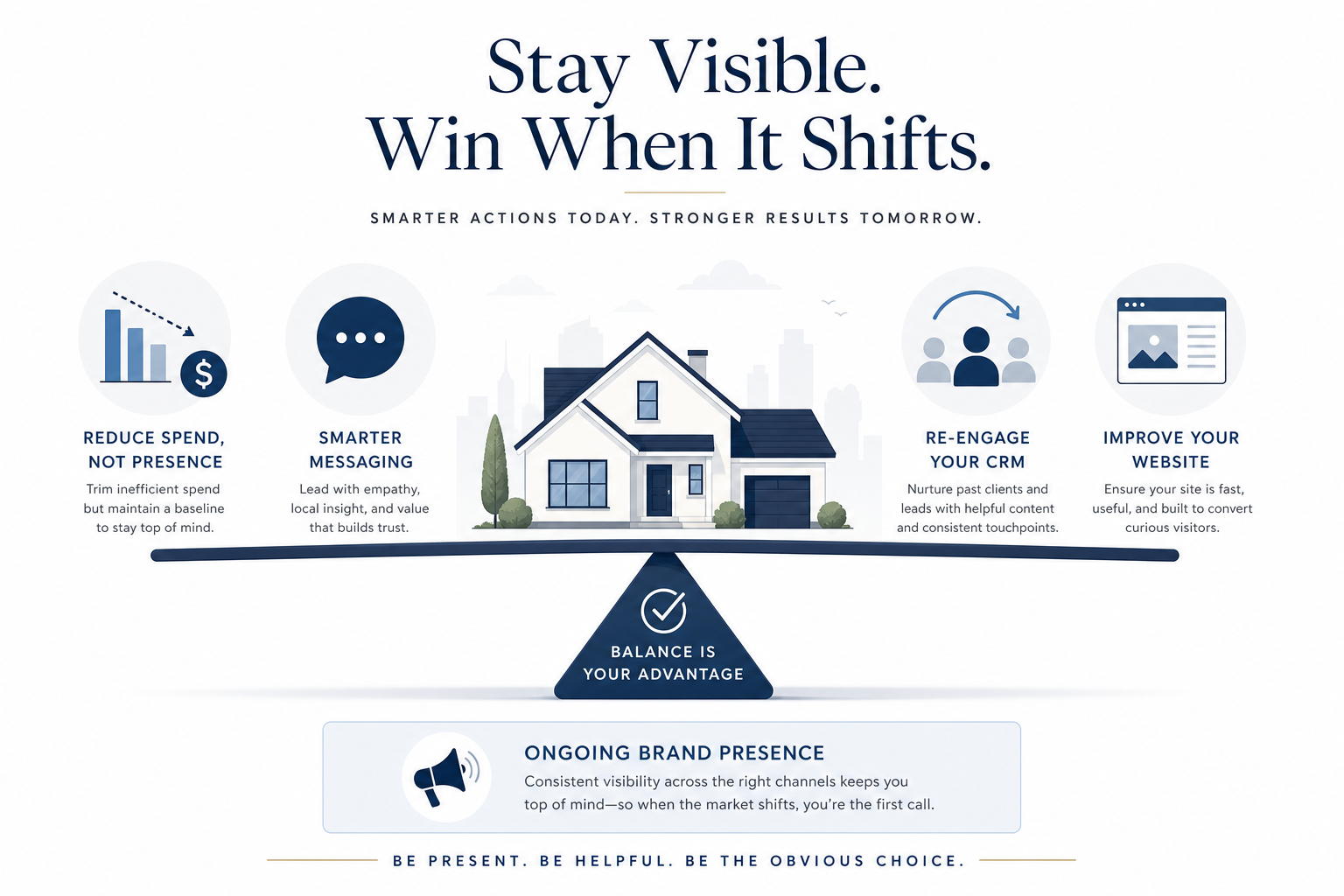
A slower or more fragile market often calls for a more disciplined communications mix:
- reduce weak media placements
- prioritize high-intent search or remarketing
- keep email and CRM audiences warm
- publish useful project or market updates
- strengthen broker communication
- improve the website and sales tools while traffic is lighter
- continue organic content that builds long-term discoverability
This is consistent with MARKETIKA's broader perspective on lead generation for real estate developers. Demand systems work best when websites, campaigns, CRM logic, and follow-up keep operating as a coherent whole, even if the pace changes.
Uncertain markets are often the best time to fix the foundation
When lead flow softens, teams usually gain something they rarely have during peak launch periods: room to improve.
This is when developers can strengthen the assets and systems that are harder to fix in the middle of a fast-moving campaign:
- sharpen positioning
- improve project messaging
- rebuild weak landing pages
- restructure the project website
- tighten CRM routing
- organize broker materials
- produce clearer visuals or FAQs
- strengthen parent-brand credibility
In other words, uncertain periods are not only for cost control. They are also for structural improvement.
This is one reason articles such as how to build high-converting real estate project websites and best website features for developers matter most when the market is less forgiving. Weak foundations become more visible.
Visibility helps preserve broker and buyer memory
A project rarely wins because someone sees it once.
Awareness, trust, and preference usually build through repeated exposure and repeated reassurance. If the project goes quiet for months, the market's mental availability fades.
Then when the developer wants momentum again, the team is not only fighting the market. It is also fighting forgetting.
That creates a hidden cost. Rebuilding familiarity is often more expensive than maintaining it intelligently.
What a disciplined visibility strategy can look like
A practical uncertain-market approach may include:
This is not about looking busy. It is about staying legible, credible, and ready.
Common mistakes during slow periods
The biggest mistakes usually fall into familiar patterns:
- cutting all visibility at once
- confusing discipline with invisibility
- stopping communication with brokers and past leads
- leaving websites or project pages stagnant
- waiting for the market to improve before fixing weak systems
These decisions often feel conservative in the moment, but they can make the next phase harder.
Final takeaway
An uncertain market is a reason to become more disciplined.
It is not automatically a reason to become invisible.
Developers who stay present, useful, and credible through quieter periods usually re-enter stronger. They protect trust, preserve awareness, and give the next wave of demand something solid to return to.


