



Pre-construction marketing has a built-in challenge.
The buyer is being asked to trust a product that may still exist mostly as drawings, renders, floorplans, and promises.
That means confidence is not a soft extra around the sale. It is one of the conditions that makes the sale possible.
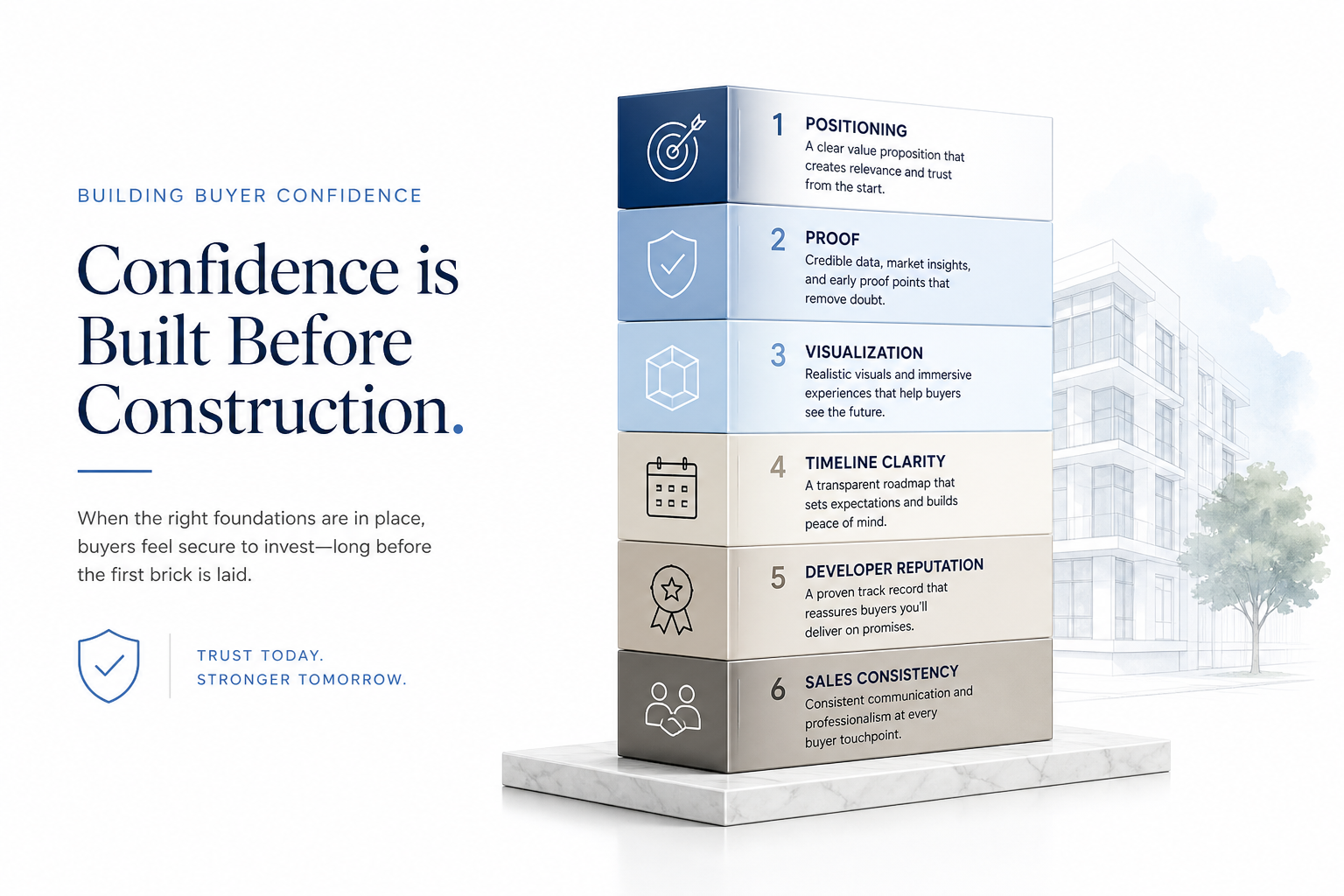
Developers build buyer confidence before construction starts by reducing uncertainty. That usually comes through clear positioning, credible proof, strong visualization, realistic communication, developer reputation, and a consistent sales experience that makes the project feel more understandable and more believable.
Confidence comes from clarity before persuasion
Many teams try to solve uncertainty with more excitement.
Sometimes what the buyer really needs is more clarity.
People become more comfortable when they understand:
- what is being built
- who it is for
- why it is distinctive
- who is behind it
- how the process works
- what happens next
Confusion creates hesitation. Clarity lowers the effort required to trust.
This is why the preconstruction buyer journey starts before the sales centre is such an important principle in broader terms. Confidence starts forming before a salesperson ever explains the project live.
Proof matters more than generic claims
Before a building exists, buyers lean heavily on proof signals.
That proof can come from:
- completed projects
- delivery history
- architecture and design partners
- detailed visuals and plans
- transparent timelines
- customer testimonials or reputation signals
- the coherence of the overall launch environment
The more expensive or commitment-heavy the purchase, the more this matters.
This is one reason proof beats claims in luxury real estate marketing is not only a branding idea. It is also a trust-building mechanism.
Visualization makes the future more tangible
Strong visuals do not merely make a project look impressive.
They help buyers understand something they cannot yet visit.
CGI, floorplans, interactive maps, and virtual tours reduce abstraction by showing:
- scale and architecture
- layout logic
- views and orientation
- amenity relationships
- the broader feel of the development
MARKETIKA's 3D visualization perspective for developers points to the same logic: the purpose of visualization is to make the future easier to evaluate.
Reputation helps carry belief
In pre-construction, the developer brand becomes part of the product.
Buyers often ask themselves whether the team behind the project can actually deliver what the marketing suggests. That is why developer reputation, leadership visibility, and evidence of past execution matter so much.
If the company feels organized, proven, and coherent, the buyer is more likely to believe the project can become what the marketing promises.
The sales experience should feel consistent with the promise
Confidence does not come only from assets on a website.
It also comes from what happens when a buyer asks for more information.
If the project looks premium but the follow-up is slow, unclear, or disconnected, belief weakens. If the website is strong but the sales presentation is generic, trust drops. The brand, website, CRM handoff, and sales behavior should all reinforce one another.
This is aligned with MARKETIKA's broader work on real estate digital sales funnels and high-converting project websites. Confidence is built through system quality, not only visual quality.
A practical confidence-building stack
A strong pre-construction trust system often includes:
The point is not perfection at every stage. The point is reducing avoidable doubt.
Final takeaway
Pre-construction marketing is not only about creating desire.
It is also about giving buyers enough confidence to believe the project can become what the marketing promises.
Developers who build that confidence well create stronger conditions for enquiry, stronger sales conversations, and more resilient trust before the first shovel hits the ground.


