



A useful pre-launch waiting list does more than collect names and email addresses. It gives buyers a clear reason to register, captures enough intent to support relevant follow-up, and gives the developer early evidence about demand, product preference, timing, and questions.
The goal is not the biggest list. It is a list the sales and marketing teams can understand and use responsibly. A few hundred people with clear preferences, valid consent, and a credible reason for joining can be more valuable than thousands of unqualified registrations who do not remember the project or expect a different offer.
For developers in the UAE, USA, and Canada, the mechanics will vary by market. UAE launches may use the language of off-plan projects and place more weight on broker and WhatsApp coordination. US new developments and Canadian pre-construction projects may need different terminology, disclosures, and buyer education. The operating principle is the same: make the exchange clear, useful, and honest.
A waiting list should do three jobs
A strong pre-launch list functions as three connected assets:
- An audience: people who have asked to hear from the project.
- A signal: information about who is interested, what they want, and when they may act.
- A launch pathway: a structured way to provide updates, previews, appointments, or other legitimate early access.
If the form only captures an email address, it may create an audience but not much intelligence. If it asks for every possible detail before explaining the project, it may create friction and reduce trust. The design challenge is to collect the smallest amount of information that will genuinely improve the next decision.
This is consistent with MARKETIKA’s pre-launch marketing framework for real estate projects, which treats the waiting-list phase as part of a staged system that connects positioning, visuals, digital experience, acquisition, and sales follow-up.
Begin with a credible value exchange
People join a waiting list when the benefit is understandable and believable. “Be the first to know” can work if the project already has a clear proposition, but it is often too vague on its own.
A stronger value exchange might include:
- Early access to approved floorplans or project information
- A private preview or presentation appointment
- Early notice of launch dates, phases, or availability windows
- Access to a guided unit comparison or project briefing
- Priority for a clearly defined appointment or information session
- Useful neighbourhood, design, or construction updates before public release
Do not promise priority allocation, pricing, discounts, or reservation rights unless those benefits are real, approved, and operationally possible. A waiting list should not create a false sense of certainty around a future offer.
The form should also explain what happens next. Tell people what they will receive, through which channels, and roughly when. Clarity at registration reduces disappointment later and gives the sales team a better foundation for follow-up.
Capture intent without turning the form into an interview
The most useful fields usually fall into four groups.
Contact and communication
Collect the information needed to respond, such as name, email, phone or WhatsApp number, preferred contact method, and language where relevant. Make it clear which fields are required and why a phone number is requested.
Product preference
Ask about the project elements that can change the conversation: unit type, bedroom count, preferred building or view, approximate size, or whether the person is interested in a specific phase. Use plain language and avoid asking about details the project cannot yet support.
Purchase context
A simple distinction between end user and investor can be useful. So can an approximate budget range and expected timing, provided the sales team has a plan for using those answers. Use ranges rather than demanding an exact figure at an early stage.
Consent and source
Separate the request to handle an enquiry from optional consent for future marketing. Record the source, campaign, landing page, form version, consent wording, and timestamp in the CRM. These fields may not be visible to the person completing the form, but they are essential to responsible operations.
A good form asks only for information the team will use. If sales never changes its approach based on a field, remove the field or make it a later-stage question.
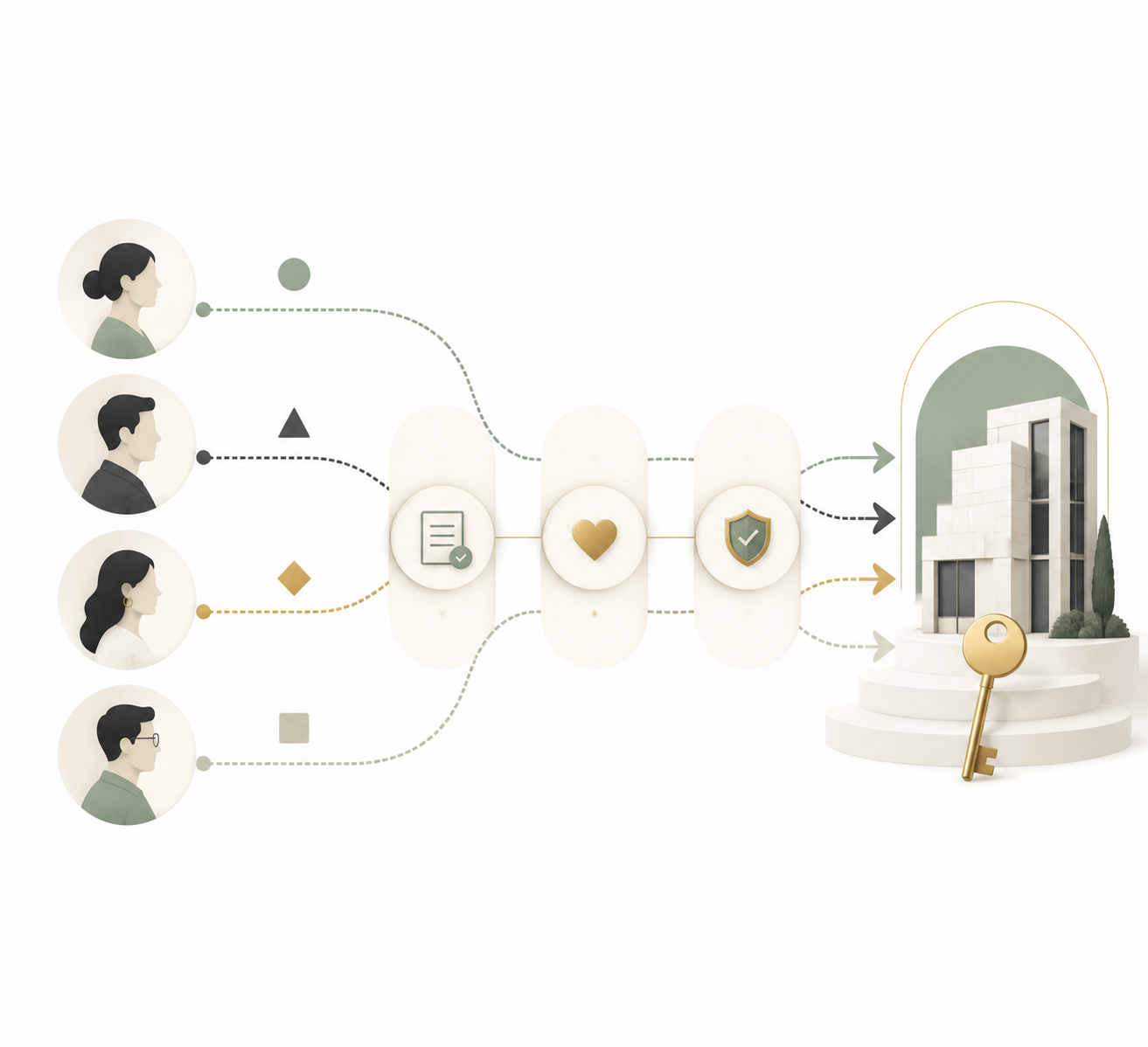
Segmentation becomes useful when it changes the next message, owner, or action.
Use progressive qualification
Not every question needs to appear on the first screen. A two-step flow can protect conversion while still producing meaningful context.
The first step can establish the project, value exchange, and basic contact details. The second step can ask one or two preference questions after the person has decided to continue. A confirmation page or welcome message can then invite the person to complete a preference profile if they want more relevant updates.
This approach avoids two common mistakes. A form that is too short may fill with vague curiosity. A form that is too long may feel like a mortgage application before the project is even understood. Progressive qualification lets the relationship become more specific as the buyer’s interest becomes clearer.
Use conditional logic where it helps. An investor may need a different follow-up path from an end user. Someone interested in a one-bedroom unit should not receive the same product update as someone researching family-sized residences. The logic should remain explainable and easy for the sales team to manage.
Segment for action, not for decoration
A segment is worthwhile only when it changes what happens next. Start with a small number of practical groups, such as:
- End users and investors
- Unit type or product preference
- Budget band
- Expected purchase window
- Local and international enquiries
- Preferred language or communication channel
Then define an action for each group. A near-term, high-intent buyer may receive a personal call or presentation invitation. A longer-term prospect may receive educational content and milestone updates. A broker may need a different information pack and an authorized contact route.
Avoid over-scoring people based on weak signals. A person who opens three emails is not automatically ready to reserve. Treat observed behaviour as a prompt for relevance, not proof of intent. The clearest signals usually come from explicit choices, meaningful actions, and direct conversations.
Connect the list to the sales workflow
A waiting list becomes commercially useful when the CRM preserves the context of the registration and makes ownership clear. MARKETIKA’s guide to lead generation for real estate developers emphasizes the connection between positioning, project websites, lead capture, CRM routing, and follow-up.
At minimum, the handoff should preserve:
- Project and campaign source
- Registration date and form version
- Buyer type and preferred product
- Budget or timing range where supplied
- Preferred contact channel and language
- Consent status and the exact marketing purpose accepted
- The owner, response status, and next action
Set a response standard before the list opens. Decide who reviews new registrations, how they are routed, how quickly the first response should happen, and what happens when the preferred product is not available. A list without ownership becomes a backlog of names.
The confirmation message should also be useful. Confirm the registration, restate what the person asked to receive, set expectations for timing, and offer one relevant next step. Do not bury the project in a long automated email full of unrelated claims.
Build a nurture sequence with real information
A pre-launch list will lose trust if every message says that something exciting is coming soon. The sequence should help people understand the project and decide whether it remains relevant.
A practical sequence might include:
- Welcome: confirm the registration, explain the next step, and provide the core project promise.
- Orientation: introduce the location, design idea, developer, or project context.
- Product clarity: share approved information about unit types, plans, amenities, or the buying process.
- Proof: show relevant developer experience, construction progress, partners, or design rationale where appropriate.
- Preview: explain what will be available at the presentation or launch and how to prepare.
- Launch update: give the confirmed timing, access process, contact route, and any important conditions.
Each message should have a job. If there is no meaningful update, it may be better to send less frequently than to create artificial urgency. The real estate digital sales funnel is strongest when every stage preserves clarity and context rather than simply increasing message volume.
Treat consent as part of the experience
A waiting list collects personal data, so the form and follow-up process should be designed with privacy and communication rules in mind. The exact obligations depend on the people contacted, the sender, the channel, the jurisdiction, and the purpose of the message. This article is not legal advice, so involve qualified counsel before launch.
Canada
The CRTC summary of Canada’s Anti-Spam Legislation states that commercial electronic messages generally require consent, identification and contact information, and a working unsubscribe mechanism. The CRTC also distinguishes express and implied consent and explains that consent must be documented and managed over time.
For a Canadian pre-construction project, do not assume that someone who downloaded a brochure agreed to receive every future marketing message. State the purpose clearly, keep the optional marketing permission separate from the enquiry itself, and make unsubscribing simple.
United States
The Federal Trade Commission’s CAN-SPAM guidance explains that the law applies to commercial email, not only large bulk campaigns. Marketing email should identify the sender, provide a clear way to opt out, and honour opt-out requests within the required timeframe. Keep the process operational, including suppression across relevant campaigns and vendors.
UAE
The official UAE government data protection laws page identifies the federal Personal Data Protection Law and related data-protection resources. Developers should confirm how the federal framework, emirate-level requirements, and any applicable free-zone regime affect consent, lead routing, analytics, storage, and marketing. Use clear language, collect only what is needed, maintain consent records, and make withdrawal practical.
The safest design pattern is simple: explain the purpose at the point of collection, separate optional marketing consent, record the version and timestamp, limit access, and honour changes promptly.
Use demand data without overclaiming
A waiting list can help the team understand demand before launch, but it should not be treated as a forecast of sales. Registrations can include curiosity, duplicate records, people outside the budget range, and buyers whose timing changes.
Use the data to test questions such as:
- Which unit types attract attention before pricing is released?
- Which markets or languages are producing meaningful engagement?
- What questions prevent people from moving to a presentation?
- Which budget ranges need clearer product or payment information?
- Are leads responding to the same promise used in the campaign?
Compare registration volume with completeness, engagement, qualified conversations, appointment attendance, and progression. This creates a more honest picture than publishing a large list number as proof of demand.

The strongest pre-launch moments connect a prepared audience with a clear, credible next step.
Measure quality from registration to launch
Use a small dashboard that follows the list through the journey:
- Landing-page conversion rate
- Percentage of registrations with usable preference data
- Consent completion and suppression accuracy
- Duplicate or invalid contact rate
- First-response time and contact rate
- Email, WhatsApp, or presentation engagement by segment
- Appointment booking and attendance
- Qualified conversation rate
- Launch participation, reservation, or next-step progression
- Opt-out rate and reasons for disengagement
The most important measure is not how many people joined. It is how many people received relevant information, understood the project, and moved to a commercially meaningful next step without losing trust.
Frequently asked questions
How early should a waiting list open?
Open it when the project has enough confirmed information to communicate a credible proposition and a real next step. That may be before every detail is public, but it should not be so early that the audience receives only vague promises.
Should the form ask for budget?
Usually, an approximate range can be useful if the sales team will use it responsibly and the field is explained clearly. Do not make an exact budget a requirement when the buyer has not yet seen enough information to answer confidently.
Does a large waiting list guarantee a successful launch?
No. List quality, affordability, product fit, follow-up, consent, and operational readiness matter more than raw volume. A smaller list with clear intent can create better decisions than a large list built from an unclear offer.
Final takeaway
A pre-launch waiting list should function as an informed audience and a disciplined source of market intelligence. Give people a real reason to join, collect only the context the team can use, segment for relevant action, connect every registration to an accountable workflow, and treat consent as part of the experience. When the list is built this way, launch day begins with better conversations instead of a database full of unanswered names.


