



Developers do not need to wait for every sales detail to be finalized before launching a useful digital presence.
In many cases, waiting too long creates its own cost. Search visibility starts later, pre-launch demand is harder to capture, early buyer questions go unanswered, and the team misses a chance to build confidence before sales materials are fully locked.
The better approach is to publish what is already stable and meaningful, while staying disciplined about what is still evolving.
A pre-launch project website can create real value before pricing is final. It can explain the project story, introduce the location, establish design direction, surface developer credibility, show early visuals, and create a clear path for registration or early access. What it should not do is invent certainty around details that remain fluid.
Start with what buyers can trust today
At an early stage, the website should not try to answer everything. It should answer the right things.
What is usually stable enough to publish:
- the project vision and positioning
- the location and neighbourhood context
- the architecture or design direction
- the developer behind the project
- the broad product logic, such as condo, rental, villa, mixed-use, or branded residence
- high-level launch timing, if approved
- a registration path for updates or priority access
That is already enough to begin building qualified attention.
For many developments, the most important job at this stage is not immediate conversion. It is helping the right audience understand why the project is worth watching.
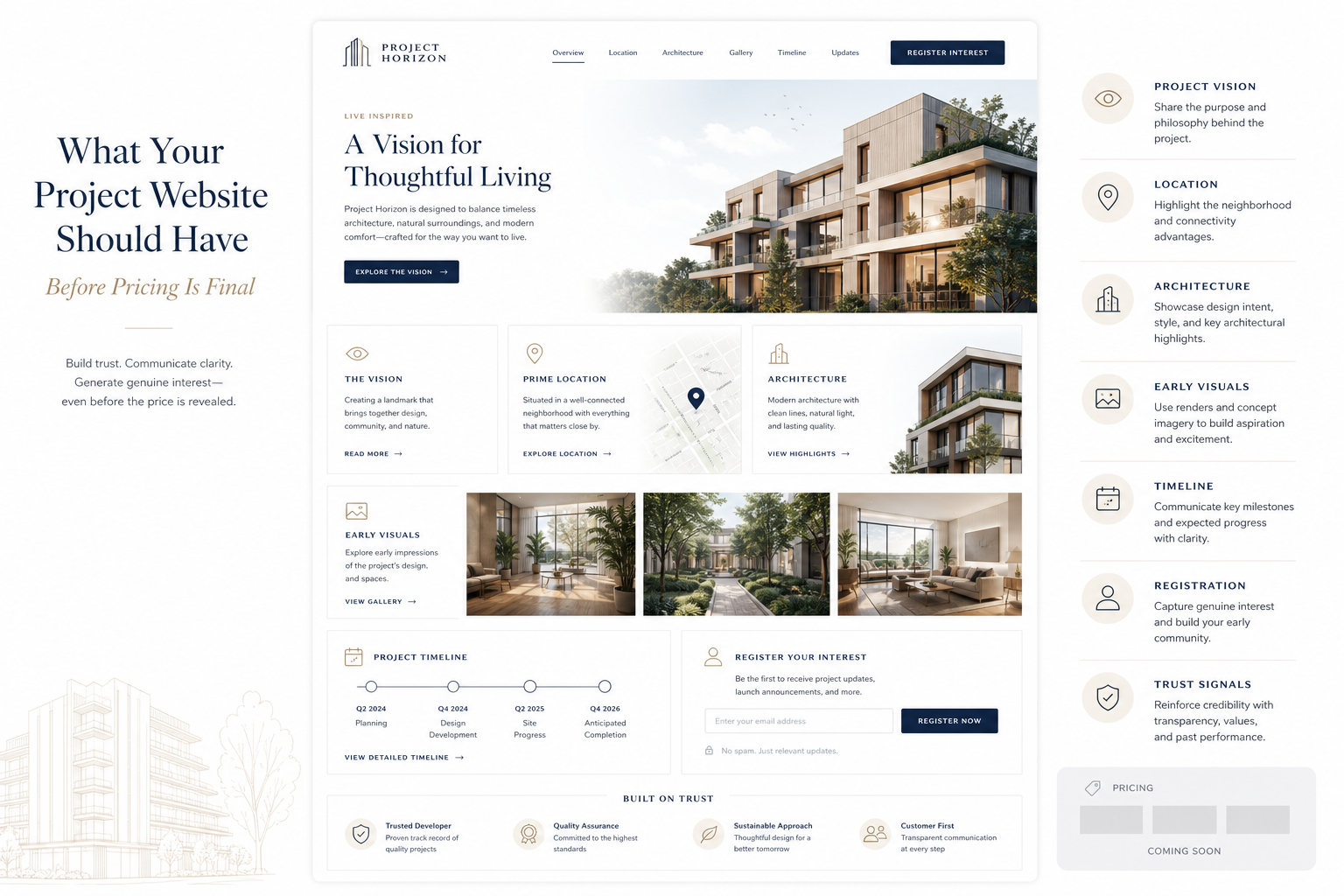
What the early website should communicate
A strong pre-pricing website usually needs five things.
1. A clear first-screen promise
The homepage should explain what kind of project this is and why it deserves attention.
That does not mean writing around the missing price. It means leading with the project story. Developers who rely too heavily on vague language such as premium living or exceptional opportunity often make the project harder to remember.
MARKETIKA's real estate developer branding blueprint is useful here. Positioning helps the market interpret the launch before detailed selling begins.
2. Location context that feels specific
At pre-launch stage, location often does more persuasive work than people realize.
Buyers want to understand not only where the project sits, but what that location means. That may include lifestyle, connectivity, nearby anchors, future growth logic, or neighbourhood identity.
A map is useful. A map plus clear explanation is better.
3. Visual proof of direction
Early renders, mood imagery, massing concepts, or architecture-led visuals can help make the project feel tangible.
The goal is not to overstate what is final. It is to help the audience picture the direction with confidence. As MARKETIKA's guide to 3D visualization for real estate developers suggests, strong visuals reduce abstraction and make future value easier to understand.
4. Credibility around the developer and partners
Before price becomes public, credibility often matters even more.
Buyers may still be deciding whether they trust the people behind the development at all. Completed projects, notable partners, leadership context, and parent-brand proof can all help here.
This is one reason developer reputation and corporate website structure are not separate from project conversion.
5. A next step appropriate to the launch stage
If price is not final, the CTA should reflect that reality.
Useful options include:
- register for updates
- join the priority list
- request project information
- speak to the team
- get notified when pricing launches
These calls to action feel more credible than pretending the entire sales environment is already fixed.
What should not appear too early
Publishing too little is a problem. Publishing unstable details is another.
Developers should be especially careful around:
- exact pricing if not approved
- unit counts that may still change
- deposit structures still under revision
- completion dates presented as fixed when they are not
- floorplans that are too early for public use
- promotional claims that overstate the certainty of the offer
The principle is simple: clarity builds trust, but false precision destroys it.
In categories like pre-construction and off-plan sales, trust is already fragile because buyers are evaluating a future product. That makes disciplined communication part of the conversion strategy.
The early website is also a research tool
A pre-launch site is not only a communication asset. It is a learning asset.
When developers publish early, they begin collecting useful signals:
- which channels bring engaged traffic
- which location messages resonate
- what buyers ask before launch
- which pages or visuals hold attention
- what percentage of visitors register interest
Those signals can improve later campaign planning, landing pages, follow-up sequences, and sales materials.
This is exactly why lead generation for real estate developers should not begin with ad spend alone. The website and CRM need to be ready to learn as well as convert.
Structure matters more than volume
An effective early site does not need to be large.
It needs to be coherent.
A lean but strong structure might include:
This is also consistent with MARKETIKA's thinking on project website checklists for developers: strong sites do real commercial work even before the full sales stack is live.
Final takeaway
A project website does not need final pricing to start creating value.
It needs a clear reason for the right buyer to pay attention, enough credible information to reduce uncertainty, and a next step that fits the stage of the launch.
Developers that wait for perfect completeness often delay momentum they could have built earlier. Developers that publish too aggressively risk confusing the market.
The strongest approach sits in the middle: publish what is stable, make the project legible, protect trust, and let the website begin doing its job before the pricing sheet is ready.


